Filming a sprint on your phone shows one thing: the shape of the movement. What it never shows is what's happening inside — the forces, the torques, the impulse. That's exactly what force plates and lab sensors measure. Understanding the difference between kinematics (what you see) and kinetics (what causes it) radically changes how you program training and prevent injury.
The problem in 30 seconds
Two athletes can look like they sprint exactly the same on video. Same knee angles, same stride length, same posture. And yet one produces 30% more horizontal force at ground contact, and the other piles 1.5× the load onto their hamstrings. Kinematics alone won't see it. Only force measurement — kinetics — reveals those gaps. That's what separates a tablet-based assessment from a real biomechanical screen.
Kinematics: the visible "what"
Kinematics describes the spatial and temporal geometry of movement: positions, joint angles, velocities, accelerations. On a sprint, it quantifies stride length, stride frequency, ground contact time, flight time, knee flexion at amortisation. It answers: "what does the movement look like?"
Tools range from a smartphone (2D, low precision) to 3D optical capture (Vicon, Optitrack, reflective markers at 120-300 Hz, sub-millimetre precision). In between: inertial measurement units (IMUs) and "markerless" computer-vision systems. Practical in the field, but with sagittal-plane angular errors of 3°-15°, and up to 57° in the transverse plane according to Colyer et al. (2018) — so for assessing dynamic knee valgus, markerless alone is too imprecise.
🔑 What kinematics sees
- • Angles (knee, hip, ankle) at every instant
- • Velocities linear and angular of each segment
- • Times of contact, flight, phase duration
- • Trajectories of the centre of mass and extremities
Kinetics: the mechanical "why"
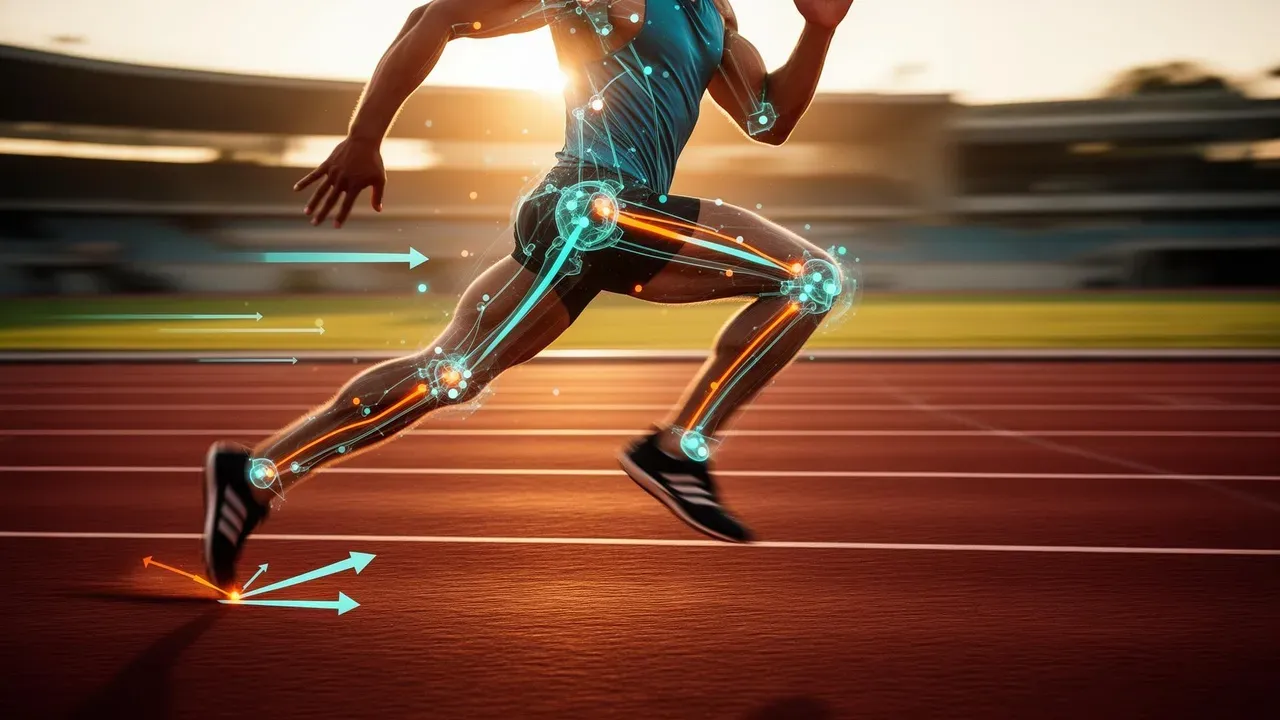
Kinetics measures the forces that cause movement. Without it, you watch the animation without understanding the engine. Key variables:
- • Ground reaction force (GRF): split into vertical, antero-posterior and medio-lateral. This is what propels the athlete.
- • Joint moments (torques): the rotational load placed on each joint. Two athletes at the same angle can experience very different torques depending on posture.
- • Mechanical impulse: force × time. Drives change in momentum — and thus sprint and jump performance.
- • Rate of force development (RFD): how quickly tension builds. Maffiuletti et al. (2016) rank it among the best predictors of performance on brief actions (< 200 ms).
The force plate is the reference instrument. It measures GRF in 3D at high frequency (typically 1000 Hz) and enables power, impulse and RFD to be computed with a precision impossible to obtain on video, no matter how slow the replay.
🎯 See what video can't show
Our 2-hour Full Test combines a force plate, isometric measures and jump tests to quantify your kinetic profile: peak force, RFD, left/right asymmetries, stretch-shortening cycle quality. You leave with hard numbers and a programme built on your real capacity — not a visual impression.
Book the Full TestTechnologies: what each tool really measures
Tools are not equal, and marketing often blurs the picture. A smartphone app that "analyses your stride" is doing degraded 2D kinematics — full stop. To sort it out:
- • 2D smartphone video: rough kinematics, perspective errors. Useful to catch a major technical fault, insufficient for clinical decision-making.
- • 3D marker capture: kinematic gold standard, heavy to deploy.
- • IMUs (inertial units): wearable, ecological, 2°-8° error — good for field load quantification.
- • Force plates: the only direct measure of kinetics. Essential for RFD, power, asymmetries.
- • Isokinetic dynamometers: isolated joint torque, useful for tracking post-surgical rehab.
Integrating both for performance
Morin and Samozino's (2016) force-velocity profile is the clearest illustration: it combines kinematics (velocity) and kinetics (force, power) to identify an athlete's dominant deficit. A sprinter may be force-limited (needs heavy squats, sled work) or velocity-limited (needs assisted sprints, overspeed). Without that duality, you prescribe blindly.
Same logic in vertical jumping: two athletes with the same squat-jump height can have opposite profiles — one produces huge peak force over 400 ms, the other moderate force in 150 ms. The first wins a weightlifting contest, the second a sprint start. Programming the same session for both is a mistake.
Injury prevention: why video alone fools you
Asymmetry is one of the best injury-risk indicators. Force-plate testing regularly reveals 10-20% left/right differences in athletes who believe they're symmetric and look symmetric on video. Across thousands of reps (running, jumping), 15% impulse difference on one leg = massive cumulative overload on that side's structures — tendons, menisci, hamstrings. That's exactly what we screen for before return to sport after ACL surgery, where video sees nothing.
FAQ
What's the difference between kinematics and kinetics?
Kinematics describes movement (angles, velocities, accelerations). Kinetics measures the forces and torques that cause it. Video = kinematics. Force plate = kinetics.
Is smartphone video analysis enough?
For a rough technical check, yes. For clinical decisions or fine optimisation, no — missing forces and limited angular precision make video-only analysis insufficient.
Why measure RFD?
Because most sporting actions last under 200 ms. Absolute strength matters less than how fast you apply it. RFD is the best predictor of performance on those brief actions.
Sources
- • Colyer et al. — Vision-Based Motion Analysis and Markerless Systems (Sports Med Open, 2018)
- • Maffiuletti et al. — Rate of force development (Eur J Appl Physiol, 2016)
- • Morin & Samozino — Power-Force-Velocity Profiles (IJSPP, 2016)
Key takeaways
- ✅ Kinematics = what you see. Kinetics = what causes it.
- ✅ Two athletes with identical movement can produce very different forces.
- ✅ RFD predicts performance on actions under 200 ms.
- ✅ 10-20% force asymmetries are invisible on video and predictive of injury.
- ✅ Force plate = only direct measure of kinetics.
- ✅ Force-velocity profile = individualised training guide, more powerful than any isolated test.
Fourth episode of our series "Physics & biomechanics of movement, explained simply". Next episode: "Why your ankles decide your sprint speed", on 25 May 2026.