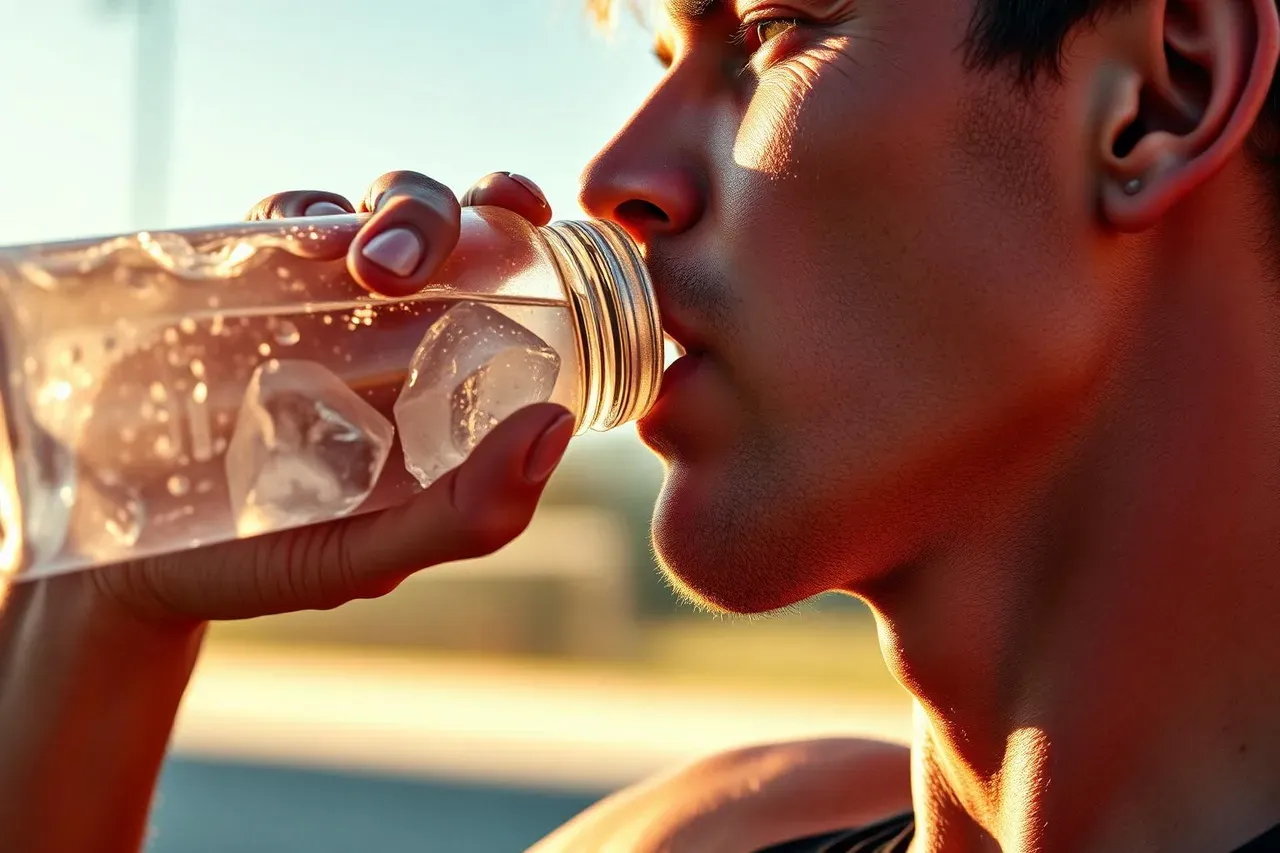
"Don't drink too cold, you'll cramp / shock your heart / bloat." We've all heard it — and it's largely wrong. Recent research shows that, in the right conditions, cold water and ice slurry are among the most effective internal cooling tools for endurance in the heat. But "cold" doesn't mean "icy at all costs": the real question is dose, context and individual tolerance.
Myths worth breaking
Three beliefs dominate: cold water causes cramps, shocks the heart, blocks digestion. None hold up against current data. Exercise-associated muscle cramps are multifactorial, dominated by neuromuscular fatigue; beverage temperature plays no demonstrated role. The "cardiac shock" belongs to cold water immersion, not ingestion. Overall gastric emptying is barely affected by temperature, though the first gastric contractions can slow transiently.
What is real: some people tolerate very cold drinks poorly — bloating, early satiety, ice-cream headache, abdominal discomfort. These reactions are individual, not universal grounds to ban cold.
What the science actually shows
The reference meta-analysis on internal cooling in the heat (Choo et al., 2023) is clear: ingesting a cold drink or ice slurry significantly extends time to exhaustion, modestly lowers core temperature, and reduces thermal sensation and RPE. Effects on self-paced time trials are more borderline, and intermittent efforts (team sports) respond variably.
Landmark trials: Lee et al. (2008), 4 °C vs 37 °C before and during cycling at 35 °C → +23% time to exhaustion. Siegel et al. (2010), ice slurry at -1 °C before running in the heat → tolerated higher core temperature and +19% running time. Burdon et al. (2010), cold drinks in humid heat → +4.9% performance.
By contrast, in temperate climates or on short, strength-heavy efforts, the benefit vanishes. Cold isn't a universal booster — it is a context-specific tool for endurance in the heat.
How it works
The main mechanism is a heat sink: cold liquid warms up in the body and absorbs calories, lowering core temperature. Ice slurry adds latent heat of fusion, which is why -1 °C often beats 4 °C in trials. Second, a sensory signal: thermoreceptors in the mouth, esophagus and stomach send a "coolness" signal that reduces perceived effort — you last longer partly because you feel better, not only because you are cooler. Third, a caveat: cold ingestion transiently reduces sweating, which limits evaporative loss — neutral in humid conditions, but the net cooling benefit is smaller than pure thermodynamics suggests in dry heat.
What we still don't know
Most studies use young active men in the lab, with samples under 15 participants. Women are underrepresented, children/adolescents and older active adults almost absent from performance trials. Many rely on time-to-exhaustion, which inflates gains vs real competition. Extra caution is warranted in people with achalasia, dysphagia, cold-triggered migraine or significant blood-pressure variability.
Practical strategy
- • Daily hydration: 10-15 °C — best palatability/tolerance balance.
- • Endurance in heat (> 30 min): 4-10 °C, with 0.5-0.7 g/L sodium.
- • Ice slurry (-1 to -2 °C): targeted use only, tested in training first.
- • Volumes: 200-300 mL every 10-20 min; target < 2% body mass loss.
🎯 Personalise your hydration strategy
Our 2h Full Test includes sweat rate, digestive tolerance under load, and electrolyte needs based on your sport. You leave with a numbers-based hydration plan — volumes, temperatures, sodium — built for your sessions and events.
Book the Full TestKey takeaways
- ✅ In heat + long endurance, internal cooling lengthens time to exhaustion by 15-23%.
- ✅ The "cold water causes cramps" myth is not supported by the literature.
- ✅ Ice slurry outperforms 4 °C water at equal volume (latent heat).
- ✅ Cold also changes perception of effort and heat, not only core temperature.
- ✅ Targets: 10-15 °C daily, 4-10 °C in heat, ice slurry only after training rehearsal.
- ✅ Fractionate: 200-300 mL every 10-20 minutes, with sodium on long efforts.