"Is this exercise really specific to my sport?" It's the question we hear most from the footballers, tennis players, hockey players and rugby players we work with. A good question — usually asked backwards, because we've come to confuse specificity with resemblance.
Specificity isn't resemblance. It's relevance.
The common belief: an exercise is specific if it visually resembles competition. The footballer should use a ball, the tennis player mimic their hitting stance, the hockey player hold a stick, the sprinter reproduce their stride under load. The problem: looking like the sport guarantees nothing about transferring to the sport.
A recent paper by Oliver Gonzalo-Skok and Julio Tous-Fajardo (head of physical preparation at FC Barcelona) re-examines "dynamic correspondence" principles in football. Game actions are variable, unpredictable and environment-dependent. A change of direction in a match is never just a change of direction: the player reads an opponent, anticipates, tracks the ball, manages balance, decides, brakes, produces force and re-accelerates — in fractions of a second. Reproducing only the appearance of the movement in a gym does not reproduce what makes it hard.
Mladen Jovanović makes the same argument: the more open and unpredictable a sport is, the less physical preparation should try to imitate it artificially. Sport practice must keep its perception, decision, timing and opposition problems. Physical preparation can isolate and build the resources needed to solve them.
🔑 The right question
Not: "Does this exercise look like my sport?"
But: "What adaptation are we after, and is this a good way to get it?"
Gym and field have different jobs
Take a footballer lacking explosiveness over the first few metres. We could invent a very "football" drill: ball, band, change of direction, light cue. It looks like football. But what problem are we actually training? If the athlete simply cannot produce force fast enough, working maximal strength, power or sprint exposure in much simpler settings is often far more relevant. The field then expresses those capacities inside the chaos of the game.
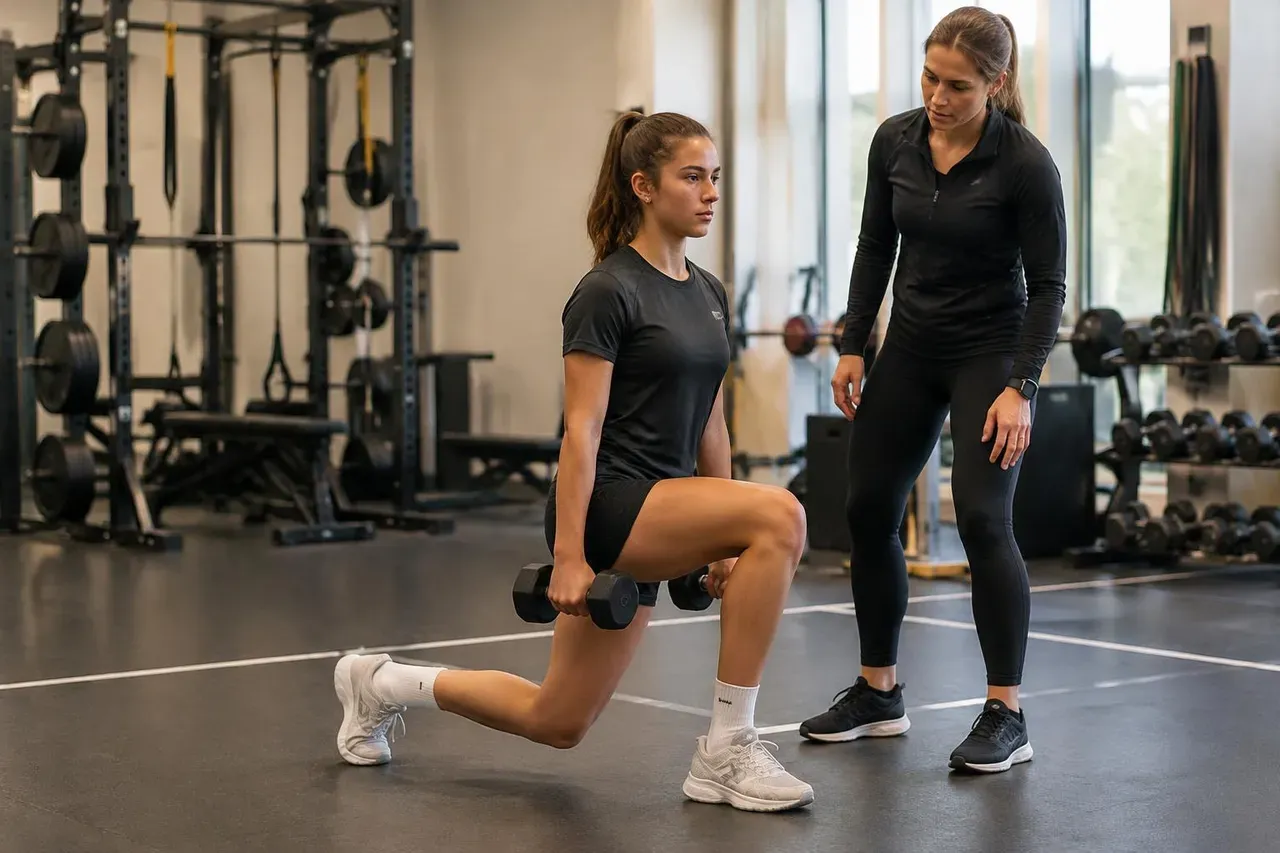
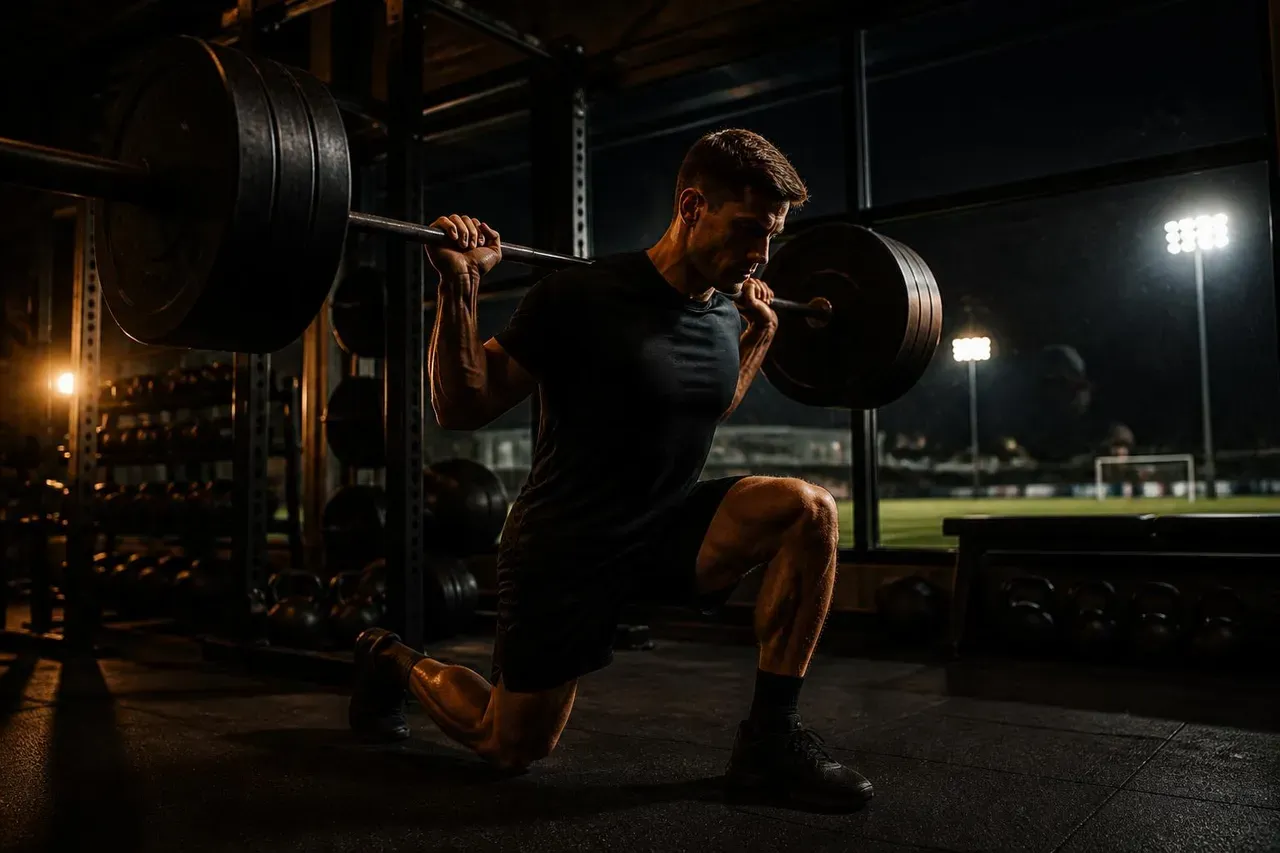
Same logic in tennis. A heavy split squat looks nothing like a forehand — yet it builds lower-limb force production the player needs. A set of lateral jumps will never reproduce a rally — but it builds the ability to absorb and rapidly re-produce force. An exercise doesn't need to copy the sport to contribute to performance.
The gym has a rare advantage: it is a controlled environment. Load, velocity, volume, range, fatigue and progression can all be managed precisely. That's exactly what's needed for qualities the sport stresses but cannot reliably progress: maximal strength, sprint exposure, plyometrics, eccentric work, deceleration ability, tissue tolerance.
🎯 Find your real limiting factors
Our 2-hour Complete Test measures strength, power, braking capacity, asymmetries and mobility on force plates and VALD tools. You leave with numbers — not impressions — and a plan built around your actual problem.
Discover the Complete TestStart with the problem, not the exercise
This is probably the most important idea. The common reflex in our field is to see an impressive exercise on Instagram or in a pro club's programme and ask: "which athlete could we use this on?" We prefer the opposite.
First, understand the problem. Is it:
- • strength? power? speed?
- • braking and change-of-direction ability?
- • tolerance to specific loads (tendons, back, knee)?
- • mobility, endurance, coordination, technique?
- • perception and decision-making?
- • or several of these at once?
💡 The reasoning to keep
Problem → target adaptation → intervention.
Never: interesting exercise → let's find a use for it.
A complicated exercise isn't a better exercise
This is one of the most common biases in modern strength and conditioning. Add an unstable surface. Then a band. Then a perturbation. Then a ball. Then a decision. Suddenly the exercise looks very "specific".
But every added constraint reduces our ability to precisely load the quality we were targeting. If the goal is lower-body strength, a simple, heavily loadable exercise is often exactly right. If the goal is reacting to an opponent, you need an open situation — usually the field. These are simply different objectives. Complexity is not a quality in itself.
A recent football review highlights the value of unilateral, multidirectional or eccentric-overload work for preparing certain game demands. But beware the opposite error: that doesn't make every unilateral exercise automatically "more functional". Again, it depends on the problem.
Three questions before picking an exercise
1. What is the real problem?
Not just what we observe, but what limits performance. A slow athlete doesn't necessarily have a "sprint problem": they may lack strength, technique, high-speed exposure — or simply sprint practice.
2. What adaptation do we want?
More force? Faster force production? Better mechanical tolerance? Better coordination? The ability to repeat efforts? You have to be able to name it.
3. Which environment does it best?
Sometimes the gym. Sometimes the field. Often both. Which is exactly why physical preparation and sport training should complement each other, not duplicate each other.
The opposite trap: getting good at lifting
Saying the gym can isolate qualities doesn't mean training an athlete like a powerlifter. The goal is never simply a bigger squat, bench or machine score. Those gains must serve something. Past a point, more maximal strength delivers far less than power work, speed work — or simply more sport practice.
The gym shouldn't imitate the sport. But it must never forget the sport either.
At Off-Field we don't chase the most impressive or most "functional" exercises. We try to understand what each athlete needs, and why. Testing helps. So does observation. Injury history, calendar, training age, sport and context all feed the reasoning. Only then comes programming: some exercises will be very simple, others far more complex; some will look like the sport, others not at all. Their appearance isn't what interests us — their role in developing the athlete is.
Key takeaways
- ✅ Looking like the sport doesn't guarantee transfer to the sport.
- ✅ The right question: which adaptation, and by what means?
- ✅ The gym isolates and loads precisely; the field integrates in real chaos.
- ✅ Start from the problem, never from the trending exercise.
- ✅ Added complexity usually reduces useful load on the target quality.
- ✅ Getting stronger in the gym is a means, not a goal.
FAQ
Does an exercise need to look like my sport to be useful?
No. What matters is the adaptation it produces. A heavy split squat looks nothing like a tennis forehand, yet it can build exactly the quality the player lacks. Visual resemblance guarantees no transfer.
Should athletes train like powerlifters then?
No. Past a certain strength level, power work, speed work or simply more sport practice will deliver more. The gym isolates qualities; the field integrates them.
Why aren't complex exercises always better?
Every added constraint reduces how much you can actually load the quality you were targeting. If the goal is lower-body strength, a simple heavily loadable exercise is usually the better choice.
🎯 A programme built on your real needs
The Complete Test (2 h, in Gland) is the starting point of every programme we build: strength, power, mobility and tolerance assessment, then a plan that addresses your limiting factor — not the trend of the month.
Book my Complete TestSources: Gonzalo-Skok & Tous-Fajardo, Movement Configuration Elements in Football Players (Sports Medicine – Open, August 2026); Mladen Jovanović, The Specificity Conundrum and the Intervention Pyramid, Parts 1 & 2 (Complementary Training, August 2026); Suchomel et al., The Importance of Muscular Strength in Athletic Performance (Sports Medicine, 2016).