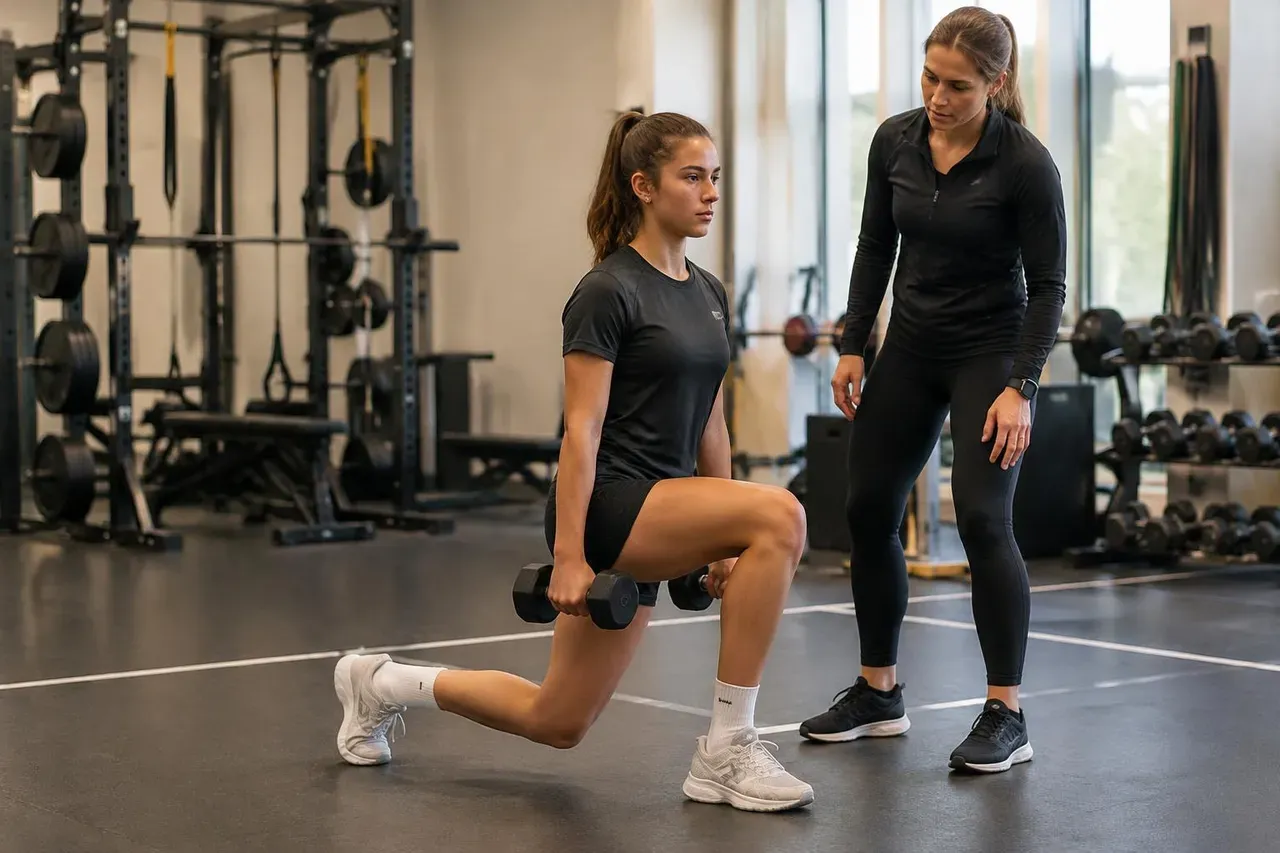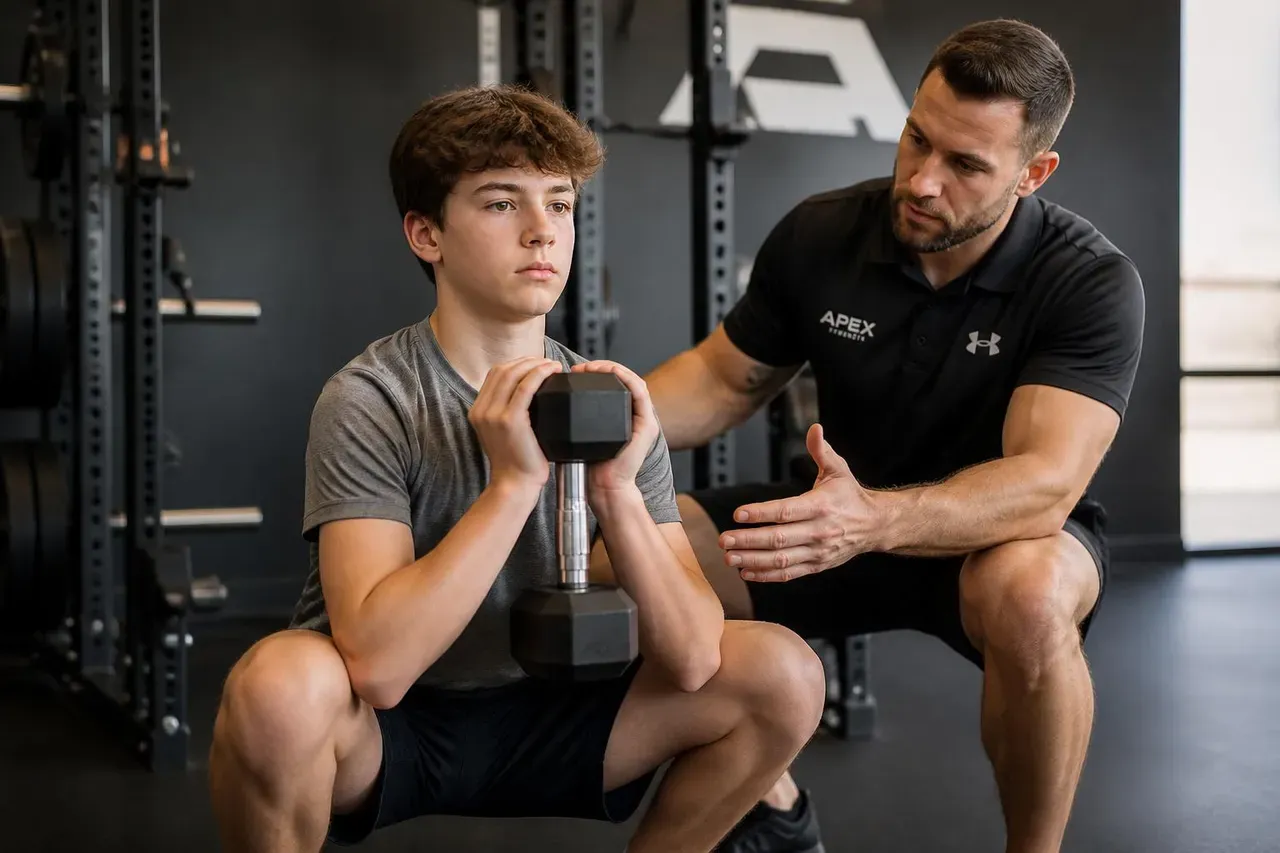
Every new sports season, the same worry: "Coach, isn't lifting going to stunt her growth?" The unanimous answer in the scientific literature for over 20 years is no. No study on a properly supervised programme has ever shown a negative effect on stature or growth plates. Better: resistance training is one of the most powerful tools to protect a young athlete from injury and build lifelong bone capital.
TL;DR — 30-second answer
No: there is no scientific evidence that properly supervised resistance training stops or slows linear growth.
Every major body — NSCA, American Academy of Pediatrics, International Olympic Committee, ACSM, UK Strength & Conditioning Association — concludes that a well-designed, supervised programme is safe for children and adolescents, with no negative effect on growth plates or final height.
ACSM puts it plainly: "there is no evidence to suggest that resistance training has a negative impact on a youth's growth potential".
On the contrary, resistance training brings documented and quantified benefits: increased bone mineral density, more than two-thirds reduction in sports injury risk (RR 0.315; Lauersen et al., 2014), improved coordination, body composition and self-esteem. No growth-plate fracture has ever been reported in a supervised youth resistance-training study.
👉 Want your child or teen to start the right way?
Our Complete Test (2h) assesses strength, mobility, and coordination before building a programme adapted to their age and sport. It's the mandatory entry point for every young athlete.
Discover the Complete Test →Where does the myth come from?
The "lifting stunts growth" myth rests on zero studies of supervised resistance training. It comes from three historical confusions that the scientific literature has dismantled at length.
Studies on child labourers (1960s)
In the 1960s and 70s, Japanese researchers — most often Kato & Ishiko (1964) — noted that children doing heavy physical labour for hours a day in mountain villages were shorter than average. These children lived under chronic malnutrition and exhausting workloads. The cause of their short stature was deprivation and overwork, not structured "training". The finding was wrongly generalised to any form of lifting.
Emergency-room statistics (NEISS)
The US National Electronic Injury Surveillance System logged tens of thousands of youth "resistance-training-related" injuries in the 1970s-90s. But as the AAP (Stricker et al., 2020) points out: "most injuries reported from resistance training occur on home gym equipment with unsafe behavior in unsupervised settings". Nothing to do with a professional setting.
Confusion between disciplines
The myth also survives because supervised resistance training is often confused with poorly supervised maximal Olympic lifting or competition powerlifting. Early AAP recommendations (1980s) did warn against maximal lifts before Tanner stage 5; that recommendation was officially reversed in 2020.
The unanimous institutional consensus
Since 2008, every major society in paediatrics, sports medicine and exercise science has issued converging position statements.
From the 2020 AAP Clinical Report (Stricker, Faigenbaum, McCambridge — Pediatrics)
"Well-designed resistance training programs have not been shown to have a negative effect on physeal (growth plate) health, linear growth, and cardiovascular health in youth."
- NSCA (2009, Faigenbaum et al.) — a well-designed programme is "relatively safe", improves strength, power, cardiovascular profile and "can increase a young athlete's resistance to sports-related injuries".
- 2014 International Consensus (Lloyd et al., BJSM) — endorsed by leading sports-medicine and paediatric organisations.
- IOC 2015 (Bergeron et al., BJSM) — consensus on youth athletic development.
- ACSM (Faigenbaum, Lloyd, Oliver, 2020) — "Childhood seems to be the best time to participate in strength-building activities that enhance bone mineral content and density."
How the growth plate actually works
The growth plate (physis) is a hyaline-cartilage disc near the ends of long bones, responsible for longitudinal growth. It stays open until the end of puberty (roughly 14-16 years in girls, 16-18 in boys), then ossifies.
Why is it considered "fragile"? Because mechanically it is weaker than the surrounding structures. Caine et al. (2006): "the physis may be 2–5 times weaker than the surrounding fibrous tissue". In a child, a force that would sprain an adult's ligament can fracture the plate (Salter-Harris fracture).
The key point — often overlooked
The physis is vulnerable to sudden, uncontrolled shear, torsion, and traction forces (falls, contacts, violent rotations) — not to the controlled, progressive axial load of a properly executed strength exercise. Across the entire literature on supervised youth resistance training, no growth-plate fracture has ever been reported.
The real risk factors for physeal fractures are: high-impact and contact sports (basketball, gymnastics, skiing, football), falls and accidents, growth spurts, unsupervised overtraining, and early specialisation. Supervised resistance training is not a risk factor — it is protective.
The quantified benefits
Reduced sports injuries
The strongest argument. The landmark meta-analysis by Lauersen, Bertelsen & Andersen (2014, BJSM) shows resistance training cuts overall injury risk to less than one third (RR 0.315), acute injuries to RR 0.647 and overuse injuries to RR 0.527. The 2018 update reports risk "more than halved" (RR 0.338), with a dose-response relationship.
Bone mineral density
Childhood and adolescence are the optimal window to build bone capital. Nichols, Sanborn & Love (2001, J Pediatr): 15 months of resistance training in adolescent girls (14-17 y) significantly increased femoral neck BMD (1.035 → 1.073 g/cm², P < 0.01), with no change in controls.
Strength gains and motor transfer
Behringer et al. (2010, Pediatrics) meta-analysis: overall effect size SMD = 1.12 on strength, with no sudden puberty "jump" — so yes, prepubertal kids do gain strength, mostly through neural adaptations (recruitment, coordination), which incidentally refutes the reverse myth ("they don't have the hormones"). Measurable transfer to jumping, sprinting and throwing (SMD 0.52).
Body composition and metabolic health
Ribeiro et al. (2022, Sports Med Open): in adolescents with obesity, improved strength (SMD 1.44), cardiorespiratory fitness (SMD 1.09), reduced fat mass and waist circumference, improved insulin sensitivity.
Self-esteem and mental health
Collins et al. (2019, Sports Med Open): positive effect on self-efficacy, physical and global self-esteem — independent of body composition changes. The act of learning and progressing feeds a sense of mastery that matters most in adolescence.
And growth itself?
The core parental question. The few longitudinal studies show identical linear growth between trained and control groups. Sadres, Eliakim et al. (2001, Pediatr Exerc Sci): 21 months of progressive resistance training in 9-year-old prepubertal boys → significant strength gains, yet "No differences were observed in the gain in body height between groups". Falk & Eliakim (2003) even show resistance training increases IGF-1 — a growth factor.
👉 Your young athlete deserves a professional setting
At Off-Field, every youth programme starts with a Complete Test (2h) led by a certified strength coach. Zero improvisation, documented progression, maximum safety.
Book the Complete Test →Age-based practical recommendations
There is no magic age: the criterion is behavioural maturity — the ability to follow instructions and stay focused. Often around 7-8 years per the AAP. Golden rule: if a child is mature enough for an organised sport, they are mature enough for adapted resistance training.
6-9 years
Bodyweight exercises, very light loads (sticks, bands). Focus on technique and play. High reps (15+). 1-2 sessions per week.
9-12 years
10-15 reps around 60% of 1RM. Simple free-weight and size-adapted machine exercises. 2 sessions per week.
Adolescence
Progression to heavier loads once technique is owned: ≤ 60% 1RM as a beginner, ≤ 80% intermediate, ≥ 80% advanced. 2-3 sessions per week. No 1RM or maximal explosive lifts (snatch) until skeletal maturity.
Non-negotiable precautions
- Qualified supervision and safe environment: the #1 safety factor.
- Technique before load — learn the movement with a light load before any progression.
- No 1RM or maximal ballistic lifts (clean & jerk, snatch) until technique is mastered and skeletal maturity reached.
- Warm-up, breathing technique (avoid forced Valsalva), child-sized equipment.
- Prior medical clearance if cardiac disease, pulmonary hypertension, or cardiotoxic treatment.
FAQ
At what age can a child start resistance training?
No magic age. Criterion is behavioural maturity: ability to follow instructions and stay focused, often around 7-8 years per the AAP. Simple rule: if they're mature enough for an organised sport, they're mature enough for adapted, supervised resistance training.
Does resistance training really stunt growth?
No. No study on a supervised programme has ever shown a negative effect on stature or growth plates. Unanimous consensus for over 20 years (AAP, NSCA, IOC, ACSM).
What are the concrete benefits for a young athlete?
More than two-thirds reduction in sports injury risk (RR 0.315), higher bone mineral density, better coordination, power and self-esteem. One of the best health investments of childhood and adolescence.
📚 Scientific sources
- Stricker et al. — Resistance Training for Children and Adolescents (AAP, Pediatrics, 2020)
- Faigenbaum et al. — NSCA Youth Resistance Training Position (2009)
- Lauersen et al. — Exercise & injury prevention meta-analysis (BJSM, 2014)
- Behringer et al. — Resistance training in children meta-analysis (Pediatrics, 2010)
🔜 Next article
We'll continue this youth series with "Long-Term Athletic Development (LTAD): age-by-age priorities" — a practical guide for parents and coaches.