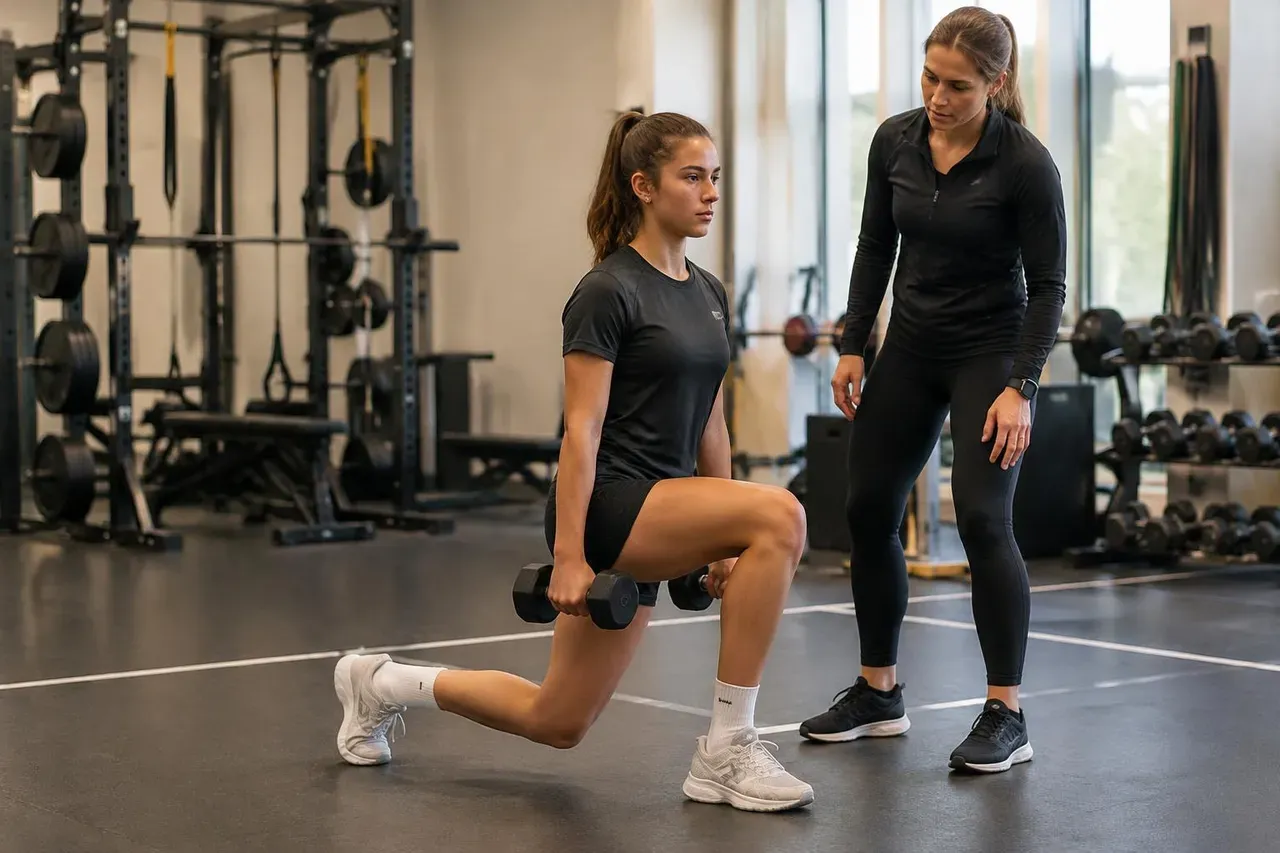

Want to get stronger but don't know how to progress? Afraid of getting injured by increasing weights too fast? Discover the science of strength training progression: how to advance intelligently, step by step, toward your goals!
What Is Progression In Strength Training?
Imagine you want to climb to the top of a mountain. You can't just jump straight to the top, right? You have to move step by step, adapting to the terrain. Progression in strength training is exactly the same!
Progression is the art of gradually increasing the difficulty of your exercises so your body adapts and becomes stronger. But be careful: progressing doesn't just mean "putting more weight on the bar"! It's much more subtle than that.
"Progression in rehabilitation and training is fundamentally non-linear. Sometimes, taking a step back is necessary to take two steps forward."
The Blanchard Model: The Non-Linear Continuum
Super smart researchers (Sam Blanchard and Phil Glasgow) created a model that explains how progression really works. And surprise: it's NOT a straight line!
🎯 The Genius Idea Of The Model
When you add something new to your exercise (for example, going from a normal squat to a squat on an unstable surface), you need to temporarily reduce other things:
- • Reduce the weight
- • Reduce the number of reps
- • Slow down the movement
- • Reduce the range of motion
This "step back" is not a failure. It's a smart strategy!
Why is this genius? Because it allows your body to adapt to the new challenge without being overwhelmed. It's like learning to juggle: you don't start with 5 balls! You start with 2, then 3, then 4...
The 5 Magic Sliders Of Progression
Imagine that each exercise has 5 "sliders" that you can adjust. To progress, you don't need to increase everything at once. You can play with ONE slider at a time!
🎚️ The 5 Micro-Adjustment Variables
1. Intensity / Load
The weight you lift. The most known slider, but not the only one!
2. Range of Motion
How far you go in the movement. For example: full squat vs half squat.
3. Height
The height of a step-up or jump. The higher, the harder!
4. Speed / Tempo
Fast and explosive OR slow and controlled. Both are useful!
5. Body Position
Two legs vs one leg, wide vs narrow, stable vs unstable.
The Control-Chaos Continuum: From Lab To Field
This model comes from the world of high-level sports. The idea is simple: you start in a super controlled environment and progress toward an increasingly chaotic environment (like a real match!).
🎢 The 5 Phases Of The Continuum
High Control
Basic movements, slow, predictable. Building confidence and base.
Moderate Control
Adding direction changes, speed increases slightly.
Control To Chaos
Sport-specific exercises, some unexpected actions appear.
Moderate Chaos
High speed (over 75% max), unpredictable movements, reactive exercises.
High Chaos
Sport "worst-case scenarios": high speed, high reactivity, like in a match!
The Neuromechanical Continuum: Choosing The Right Exercise
This framework helps you choose the perfect exercise for your current level. It ranks exercises from "easy" to "difficult" based on 3 criteria:
🧩 Complexity
- • How many joints are moving?
- • Machine (stable) vs free weights (unstable)?
- • Single plane vs multiple planes?
🆕 Novelty
- • New body position?
- • New motor pattern?
- • New equipment?
🧠 Familiarity
- • Already done this movement?
- • How many times practiced?
- • How well mastered?
The golden rule: To progress, move ONE STEP forward on this continuum. To regress (if it's too hard), step back one step. Simple!
Regression: The Secret Weapon Of Champions
Many people think "regressing" is bad. Wrong! Regression is a powerful tool when used intelligently.
🎯 When To Regress?
When you start compensating (bad posture, parasitic movements)
When you have pain that doesn't go away within 24h
When introducing a new stimulus (unstable surface, unilateral exercise...)
After an injury or a period without training
Remember: taking a step back to take two steps forward is PROGRESSING!
The 4 Factors That Block Progression
A scientific study identified the 4 main factors that prevent people from progressing:
Previous Physical Inactivity
The most important factor! If you've never moved before, it takes longer.
Lack Of Education
Not understanding how it works = harder to progress.
Session Absences
The more sessions you miss, the more you stagnate. Consistency is king!
Advanced Age
We can't change it, but we can compensate with the other factors!
These 4 factors explain 41% of non-progression. Good news: 3 out of 4 are modifiable!
The Physio's Decision Tree
Here's how professionals decide whether to progress you or not. It's a loop that repeats every session:
🔄 The Progression Loop
Step 1: Observe
Is the exercise done with proper technique? Are goals being met?
Step 2: Evaluate
Is there pain? Swelling? Has the body recovered?
Step 3: Decide
Progress? Maintain? Or regress?
Step 4: Adjust
Modify ONE slider (load, range, speed, etc.)
Step 5: Repeat
Back to step 1 at the next session!
Essential Exercises And Their Progression
Here are some concrete progression examples for the most important exercises:
🦵 Squat Progression
Level 1: Assisted squat (holding a fixed bar)
Level 2: Goblet squat (weight in front)
Level 3: Back squat (bar on shoulders)
Level 4: Front squat (bar in front)
Level 5: Single-leg squat (pistol squat)
💪 Push-Up Progression
Level 1: Wall push-up (standing against a wall)
Level 2: Incline push-up (hands on a bench)
Level 3: Standard push-up (on the floor)
Level 4: Decline push-up (feet elevated)
Level 5: One-arm push-up
🏋️ Deadlift Progression
Level 1: Hip hinge with stick
Level 2: Romanian deadlift (RDL) with dumbbells
Level 3: Conventional deadlift
Level 4: Single-leg RDL
Level 5: Sumo or deficit deadlift
The Role Of The Brain: Neurocognitive Progression
Progression isn't just physical. Your brain must also progress! This is called the neurocognitive dimension.
🧠 From Internal Focus To External Focus
At first, you focus on your body: "How is my knee moving? Is my posture good?"
Progressively, you must shift to an external focus: "How do I catch this ball while landing?"
This transition from conscious control to reactive automaticity is the mark of true progression!
At Off-Field: Scientific Progression
At Off-Field, we use these scientific principles to create personalized progression programs. Thanks to our testing technologies, we can:
- ✓Precisely evaluate your current level (ForceDecks, Output Sports, etc.)
- ✓Identify the right "sliders" to adjust for you
- ✓Track your progression with objective data
- ✓Adapt the program in real-time based on your response
🎯 Ready To Progress Intelligently?
Discover our scientific approach to physical preparation. Our expert coaches guide you step by step toward your goals, using the latest advances in movement science.
Discover Physical PreparationTesting: The Foundation Of All Progression
How do you know if you're really progressing? With objective tests! It's the only way to scientifically measure your improvements.
📊 Measure Your Progression With Testing
Our testing sessions evaluate your strength, power, speed, and balance. You get a complete profile and a personalized action plan to progress effectively.
Book A Testing SessionThe key message: Progression in strength training is not a race. It's an intelligent journey where every step counts. With the right tools, the right knowledge, and the right coaches, you can progress safely and effectively toward your goals. A strategic step back can be worth ten steps forward!