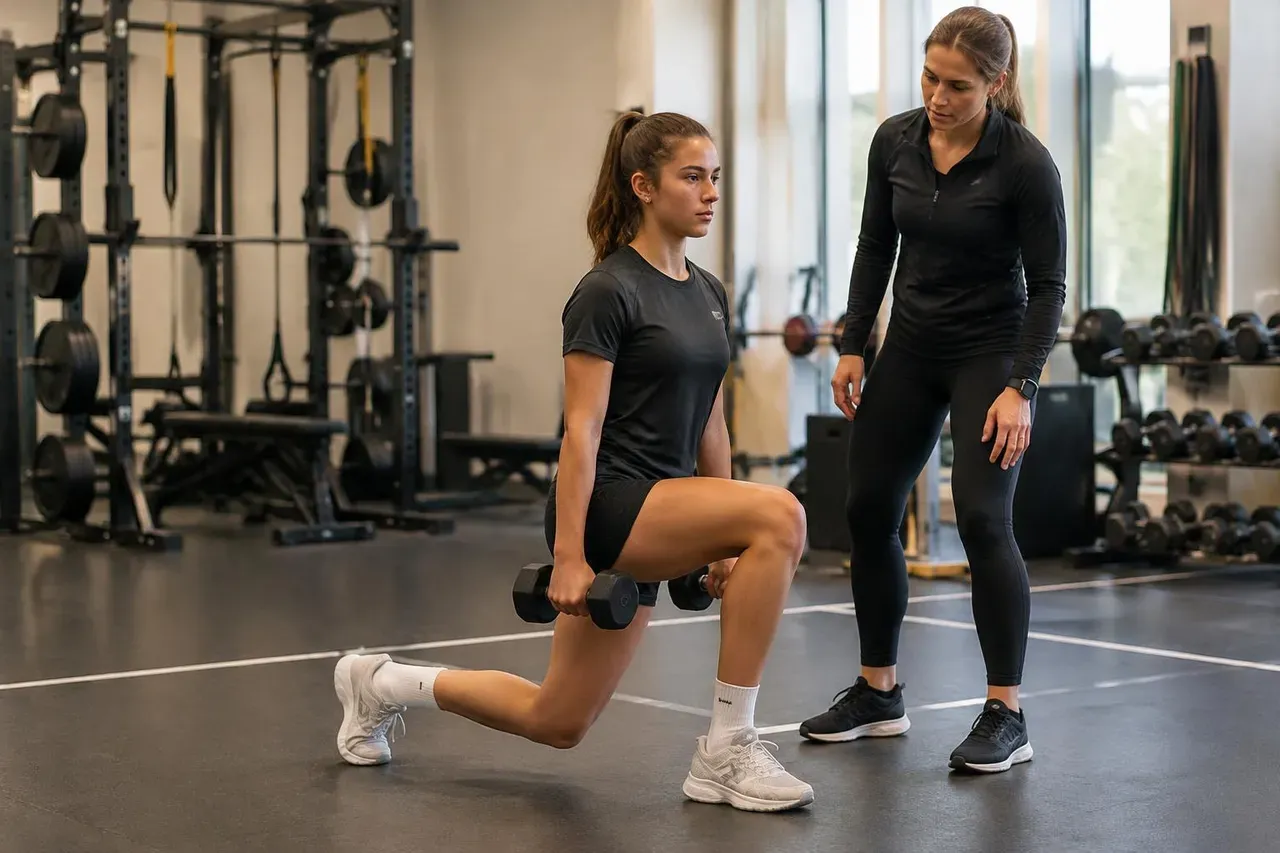
"It has to be specific." Probably the most used — and most misunderstood — phrase in strength and conditioning. It's often used to justify an exercise that looks like the sport, without ever stating which problem it solves. An exercise is relevant if it addresses a clearly identified problem, with a controllable dose, and if we know which signal to watch to keep it, change it or drop it.
The trap: specific vs similar-looking
The logic is seductive: if an exercise looks like the sporting action, it should transfer better. Sometimes true. But visual similarity tells us nothing about which problem the exercise solves, whether the stimulus is sufficient, or whether the sport already provides a better version of that action. Training-transfer research (Issurin, Sports Med 2013) is clear: transfer depends on the overlap of qualities trained and the dose, not on movement resemblance.
A small-sided football game looks exactly like football, yet guarantees no exposure to maximal speed. A knee extension looks like no match action at all — and may still be the cleanest way to load the quadriceps of an athlete who genuinely needs it. The right question isn't "is it specific?" but "specific to what, and for which problem?"
🔑 Two shortcuts to avoid
- • "Sport-specific" — copying the movement's shape without checking the limiting factor or the dose.
- • "Functional" — validating a family of exercises before defining the job it must do.
The intervention pyramid: individualise only when you have a reason
Mladen Jovanović's framework places the reason for intervening before the choice of exercise. Start general, and add precision only when the available information justifies it.
1 · Human
Which general physical capacities must stay available in any athlete?
2 · Sport
What does the sport demand? What does it already provide in abundance? What does it under-dose or threaten?
3 · Athlete
What is genuinely different about this athlete, today?
4 · Event
What changes temporarily for this competition or phase of the season?
Key point in our practice: the Full Test gives a first snapshot and lets us build a hypothesis. It doesn't give a definitive truth about the athlete. Individualisation must then be earned through information: training response, test progression, club load, match minutes, pain, sleep, availability and behaviour under fatigue.
Classify the problem before correcting the athlete
In open sports, a poor action doesn't automatically mean a poor physical quality. A player late on a defensive transition may lack speed — or may start from a bad position, read the play too late, follow an impossible tactical instruction, or all of the above.
Three families of problems
- Capacity / dose — the athlete lacks a capacity, doesn't tolerate an exposure, or isn't exposed enough. Strength and conditioning is the primary intervention.
- Skill / information — the issue lies in perception, timing, decision-making or tactics. Representative practice and sport coaching come first; S&C supports without pretending to replace the sport.
- Mixed — physical resource and sporting solution interact. Coordinate both: the gym builds the resource, the field checks whether it's used better in the real problem.
🎯 Identify your real limiting factor
Our 2-hour Full Test measures strength, power, asymmetries, force-velocity profile, mobility and aerobic capacity — so we replace "I think" with a measured hypothesis about what your sport actually under-doses.
Book the Full TestThree concrete examples
1. Footballer lacking maximal speed. The club provides plenty of accelerations, decelerations and play, but the player rarely exceeds 90-95 % of his top speed. Adding "specific" small-sided games just adds what he already does. Controlled maximal sprint exposure — also protective for the hamstrings (Haugen, 2019) — is more relevant, even though it looks less like the game.
2. Return-to-sport with a quadriceps deficit. After a knee injury, making every exercise "functional" too early dilutes the stimulus. If the identified problem is insufficient local quadriceps capacity, a heavy knee extension or a long isometric has a very clear job. Reintegrating jumps, braking and changes of direction comes afterwards — the logic of criteria-based return-to-sport frameworks (Buckthorpe, 2019).
3. Ice hockey player with a poor first stride. A weak first push on ice may come from a strength or power deficit, insufficient exposure to certain speeds, but also from skating technique and timing. Our job is to check what is modifiable off the ice — and not to turn the gym into a fake rink.
The 6-question audit before adding an exercise
- What is the observable problem? Describe what degrades, under which conditions, and what would count as improvement.
- Capacity, skill/information or mixed? Don't automatically send a sporting problem to the gym.
- What does the sport already provide? Avoid duplicating abundant and costly exposures.
- What does the sport under-dose or threaten? Strength, speed, tissue, aerobic capacity, recovery: find the real intervention windows.
- Why this exercise and this dose? The choice must be tied to the job, not to the aesthetics of the exercise.
- What feedback would change the plan? Define the signal in advance: performance, tolerance, pain, exposure, field transfer, adherence.
What changes on Monday morning
- ✅ Stop using "specific" as a synonym for "looks like the sport".
- ✅ Start every programme with a problem and a hypothesis, not with a family of exercises.
- ✅ Treat the Full Test as a starting point, then individualise with monitoring data.
- ✅ Own isolation work when it cleanly loads a resource the sport doesn't provide enough of.
- ✅ Require a feedback signal for every individualised bet: if you don't know what would change your mind, the bet is too vague.
A note on evidence: the intervention pyramid is a coaching framework, not a systematic review. Its value lies in the quality of the questions it forces you to ask before programming; the biomechanical and clinical claims that follow must be verified separately in the literature.
🎯 Let's build your programme around a problem, not a trend
Every Off-Field pathway starts with the Full Test, then a written hypothesis: what your sport already provides, what it under-doses, and the signal we'll monitor to adjust.
Book the Full Test