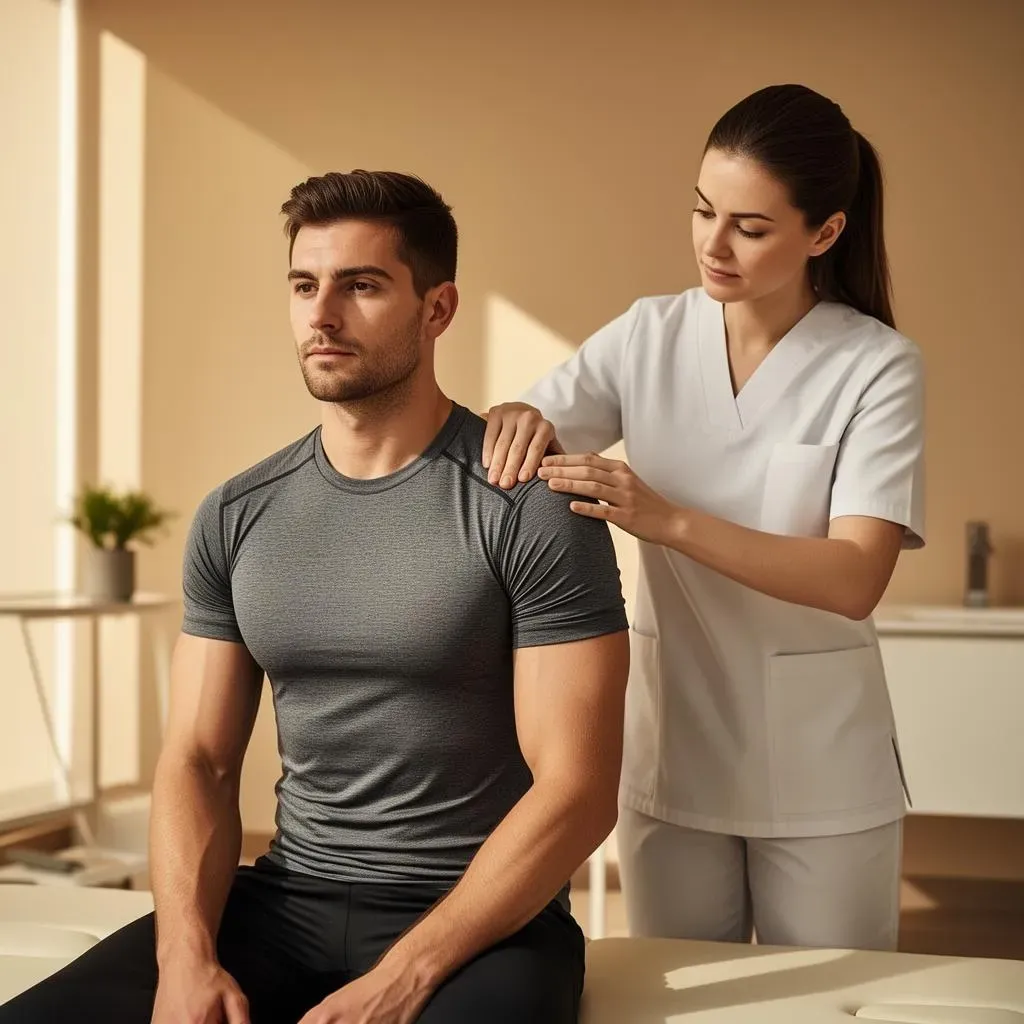
Rotator cuff tendinopathy (often mistakenly called "shoulder tendinitis") is the most common musculoskeletal disorder at the shoulder. On the Lake Geneva arc — Morges, Gland, Nyon, Rolle, Préverenges, Saint-Prex, Aubonne, Allaman — patients who sail, play tennis, swim, or do manual work are particularly affected.
Need a physiotherapist near Morges?
Book onlineThe shoulder: a complex joint
The shoulder is the most mobile joint in the human body, but also one of the most unstable. It relies primarily on the rotator cuff — a group of 4 muscles — for stability and movement.
The supraspinatus tendon is most commonly affected due to its vulnerable anatomical position under the acromial arch. We speak of cuff tendinopathy rather than tendinitis (pure inflammation is rare).
Typical symptoms
- • Pain on the side of the shoulder, sometimes radiating into the arm (but not below the elbow)
- • Painful arc between 60 and 120° of lateral arm elevation
- • Difficulty sleeping on the affected side
- • Weakness when lifting overhead
- • Progressive stiffness if untreated
The most common triggering factors
1. Overhead sports
Sailing on Lake Geneva, tennis (Morges-Préverenges, Gland, Nyon clubs), swimming, CrossFit, or throwing sports heavily load the cuff overhead. A poorly planned training load is the #1 cause.
2. Manual and postural work
Painting, carpentry, viticulture (the Lavaux and La Côte vineyards), or static office postures all increase strain on the periscapular muscles.
3. Age and degeneration
After age 50, natural tendon degeneration makes the cuff more vulnerable. But age is not a fatality — an adapted program remains very effective.
4. Deconditioning after inactivity
Returning to sport after a long break without progressive preparation is a classic of post-vacation consultations.
Diagnosis in physiotherapy
Diagnosis is primarily clinical. The physiotherapist performs a battery of specific tests: Jobe, Hawkins-Kennedy, Neer, Patte, Lift-off. Imaging (ultrasound, MRI) is not systematic.
Need a physiotherapist near Morges?
Book onlineThe validated treatment protocol
International guidelines (BJSM, ESSKA) are clear: progressive exercise therapy is the first-line treatment.
Phase 1 — Relief (weeks 1-3)
- • Load modulation
- • Targeted manual therapy
- • Isometric exercises (pain ≤ 3/10)
- • Therapeutic education
Phase 2 — Strengthening (weeks 4-8)
- • Slow progressive eccentric exercises
- • Scapular stabilizer strengthening
- • Proprioceptive work
- • Heavy Slow Resistance (HSR)
Phase 3 — Return to sport (weeks 9-12+)
- • Ballistic and plyometric work
- • Progressive sport-specific gestures
- • Home maintenance program
Common mistakes to avoid
- • ❌ Prolonged total rest
- • ❌ Repeated injections without rehab
- • ❌ Aggressive stretching in acute phase
- • ❌ Premature return to sport without strength testing
- • ❌ Relying only on massage and passive therapy
FAQ — Shoulder tendinopathy
How long to heal from shoulder tendinopathy?
On average 8 to 12 weeks with a rigorous protocol. Chronic cases may require 4 to 6 months. Consistency in exercises is the #1 success factor.
Is a cortisone injection necessary?
Not as first-line treatment. Current evidence shows short-term relief but possible long-term tendon weakening. Useful only in case of intolerable pain preventing rehab.
What's the wait time for an appointment?
Off-Field is in Gland, 20 min from Morges, 8 min from Nyon and 10 min from Rolle by car. We typically offer a first appointment within 3 to 7 days. Sessions are reimbursed by LAMal with a prescription.
How to reach Off-Field from Morges, Nyon or Rolle?
By SBB train: about 12 min from Morges, 5 min from Rolle or Nyon, then a 15 min walk (1.1 km) or 5 min by bus. By car: A1 Gland exit. Free parking. Address: Route des Avouillons 17c, Gland.
Can I keep sailing or playing tennis?
Often yes, by adapting volume and intensity. Rule: pain must not exceed 3/10 during activity, nor worsen the next day. Your physio helps you dose.
Is surgery necessary?
In over 80% of cases, no. Surgery is considered for significant ruptures, failure of 6 months of well-conducted rehab, or in elite athletes.
Need a physiotherapist near Morges?
Off-Field Center — Route des Avouillons 17c (Box 26-27), Gland · Mon–Fri 7:30am – 7:30pm · Sat 8am – 9am and 11am – 12:30pm