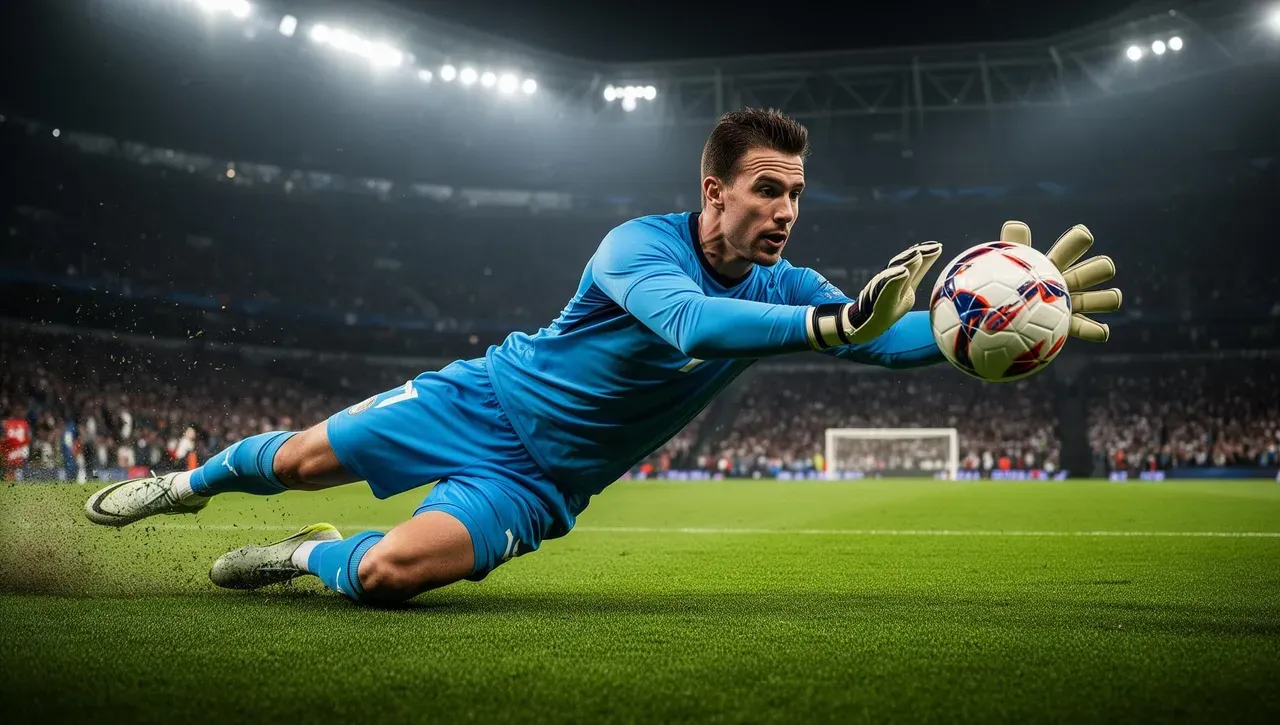
The goalkeeper position in football presents unique physical demands, distinct from those of outfield players. Although they cover less distance and perform fewer sprints than outfield players, a goalkeeper must be capable of instantly producing maximal efforts on decisive actions (jumps, dives, explosive movements). These actions, while infrequent in volume, are often decisive for match outcomes.
🎯 Want to evaluate your goalkeeper physical abilities?
Discover the Complete TestSpecific Physical Demands of the Goalkeeper
Goalkeepers have a very different effort profile than outfield players. An elite-level goalkeeper covers an average of about 5 km per match, with less than 1% at high intensity (sprints). The total distance sprinted by a goalkeeper is often less than 20 m cumulative per match, compared to hundreds of meters for outfield players. This data confirms the emphasis on brief, explosive efforts rather than repeated prolonged running.
Due to these demands, the physical capacities to prioritize in goalkeepers are explosiveness, power, and reactivity, more than pure aerobic endurance. Tests conducted on professional players show that goalkeepers display power and reflex qualities at least equal to, if not superior to, outfield players. For example, goalkeepers show vertical jumps comparable to the most explosive strikers and significantly better than defenders or midfielders. In one study, pro goalkeepers averaged ~42 cm on the countermovement jump (CMJ).
📊 Ideal Goalkeeper Physical Profile
- • Explosive power (vertical and lateral jumps, leg and arm thrust)
- • Movement speed over short distances
- • Multidirectional agility
- • Outstanding neural reactivity
- • Specific endurance to last a full match
- • Flexibility to reach the most difficult balls
Importance of Physical Tests and Data Utilization
Physically evaluating a goalkeeper provides crucial added value for guiding training. Rather than relying on impressions, tests offer objective measurements of the player's abilities. As physical trainers indicate, "fitness assessment is essential to apply results to individual training planning."
Test data allows for program personalization: for example, emphasizing the development of a quality identified as insufficient, or maintaining a strength already above average. "Stop guessing, start assessing" summarizes the idea that we should stop guessing an athlete's abilities and instead measure them concretely.
1
Identify physical strengths and weaknesses
2
Design a customized program
3
Track effectiveness and adjust
Lower Body Power and Strength Tests
Leg power is arguably the most crucial quality for a goalkeeper: it determines jump height, lateral dive distance, and explosive movement speed.
🦵 Countermovement Jump (CMJ)
This test involves performing a vertical jump starting from standing, quickly flexing then propelling as high as possible. Height achieved is measured (with camera, contact mat, or ideally a force platform).
The CMJ measures concentric explosive leg power, including the stretch-shortening cycle contribution. It's a major indicator of goalkeeper performance on vertical flights (saves under the bar, aerial ball catches). A good goalkeeper typically shows a high CMJ: professional goalkeepers often achieve 40 to 45 cm (or more).
🔽 Squat Jump (SJ)
This jump is performed from a squatting position (about 90° knee flexion), held for one to two seconds, before jumping vertically without momentum or countermovement.
The SJ evaluates purely concentric leg power. Comparing CMJ vs SJ provides indications of elastic cycle contribution: if CMJ is much higher than SJ, it indicates good stretch reflex utilization.
↔️ Single-Leg Jumps
Goalkeeper movements frequently occur on a dominant support. It's therefore relevant to test left vs right leg power and explosiveness.
The goal is to detect any asymmetry. If significant asymmetry is measured (>10-15%), training can include targeted unilateral strengthening on the weaker leg.
⚡ Reactive Strength Index (RSI)
The RSI is an indicator of plyometric explosiveness. It's measured via a Drop Jump: the goalkeeper jumps from a box (e.g., 30 cm) and, upon touching the ground, rebounds as high as possible.
RSI is calculated as the ratio between rebound height and ground contact time. A high RSI means the athlete generates great impulse in very brief contact – a crucial quality for a goalkeeper who must spring with very short ground contact.
🎯 Ready to measure your power?
Our complete testing battery evaluates all goalkeeper physical qualities: CMJ, RSI, maximum strength, and much more.
Book a Complete TestSpeed and Agility Tests
In match situations, a goalkeeper performs explosive movements over very short distances. The 5 m distance is particularly relevant, as most goalkeeper sprints in matches occur within this range.
🏃 Short Sprint 5 m and 10 m
Timing the goalkeeper over very short straight-line distances with timing gates. A good level goalkeeper is expected to show explosiveness comparable to outfield players.
References: 5 m in ~1 second, 10 m in ~1.8-2.0 seconds for elite athletes.
↔️ 5-10-5 Agility Test (Pro Agility Shuttle)
The goalkeeper starts at center, sprints 5 m right, abruptly changes direction to cover 10 m left, then returns 5 m to center.
This test engages lateral thrust, deceleration and re-acceleration. A good time reflects excellent lateral movement ability – essential for covering goal width.
🔀 T-Test Agility
Running in a T pattern: forward sprint 10 m, then lateral shuffle 5 m right, shuffle 10 m left, back shuffle 5 m to center, then backward run 10 m.
This test evaluates forward, lateral, and backward movement speed as well as transitions between directions.
Specific Endurance and Cardiovascular Capacity
Although aerobic endurance is not the most determining factor of goalkeeper performance, it should not be neglected. A goalkeeper must remain focused and lucid for 90 minutes.
🔄 Yo-Yo IR1-GK (Goalkeeper Version)
The Yo-Yo IR1-GK maintains the classic Yo-Yo audio and progression, but modifies movement: instead of 2x20 m running, the goalkeeper performs 4 movements of 4 m per level (16 m total per level).
Specifically, starting from line A: side-shuffle 4 m to line B, return shuffle 4 m to A, then backpedal 4 m and advance 4 m to return to A.
Reactivity and Reaction Time
Reflex saves on the line, rushes on deflected balls, penalties… The neuro-cognitive component is an aspect to evaluate for goalkeepers.
👁️ Visual Reaction Test
Devices with random visual signals (FitLight, BlazePod) or apps measuring reaction time to a flash.
Studies show professional goalkeepers achieve significantly shorter reaction times than outfield players on complex visual stimuli.
Flexibility and Joint Mobility
Good flexibility allows reaching distant balls without injury, cushioning falls, and having greater movement amplitude.
🧘 Sit and Reach
Classic test of hamstring and lower back flexibility. A low result indicates tight hamstrings, potentially limiting performance and increasing strain risk.
🦵 Adductor Flexibility
Adductors are particularly stressed during lateral movements and splits. Detecting stiffness helps prevent injuries.
💪 Shoulder Mobility
The Apley Scratch Test evaluates shoulder range, needed for reaching balls in backward extension.
🔄 Functional Mobility
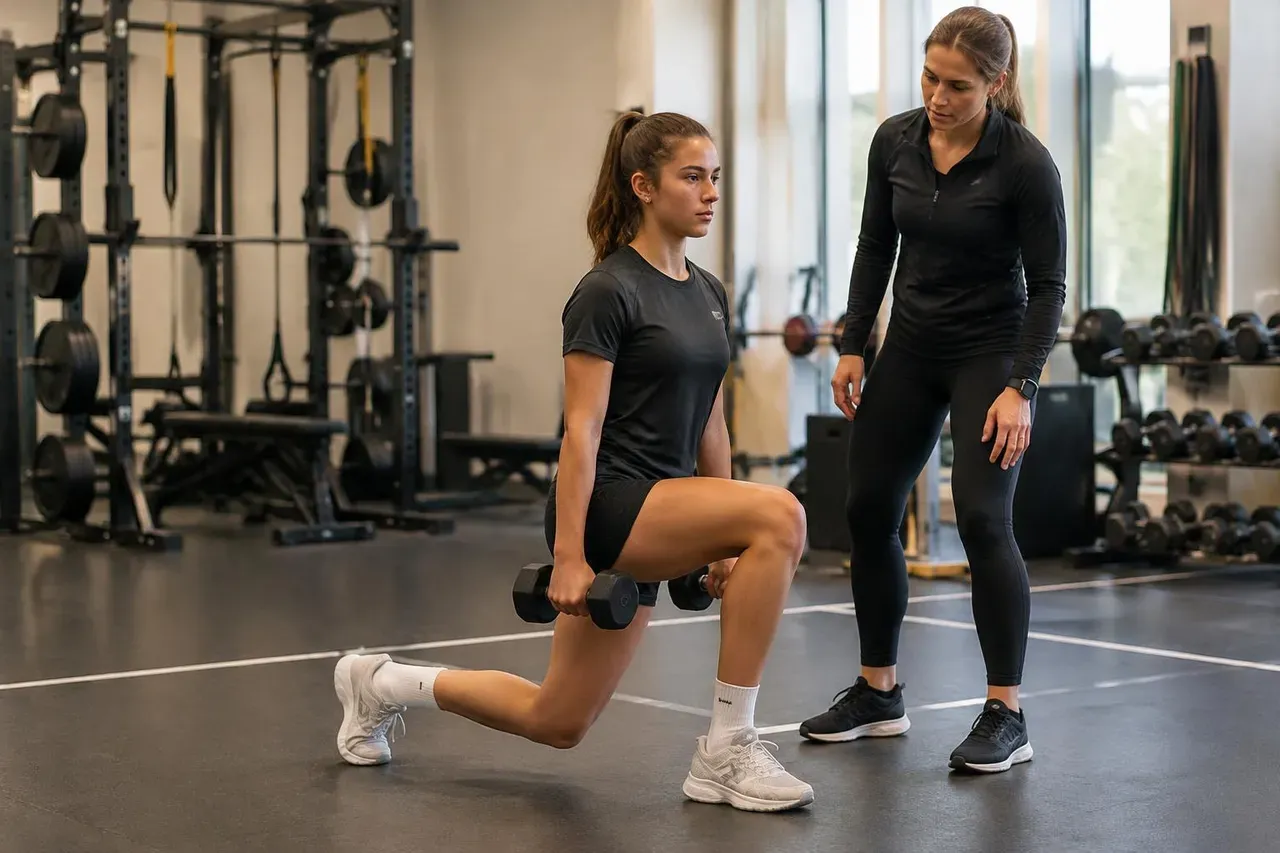
Exercises like deep squat, lunge, trunk rotation to ensure no major restriction handicaps the goalkeeper.
💪 Ready to progress?
Discover our physical preparation coaching to improve your goalkeeper qualities in a structured and supervised way.
Discover physical preparationFrom Evaluation to Training: Interpreting Results
Once tests are completed and the goalkeeper's physical profile is established, the crucial step is interpreting results and using them to optimize training.
📉 Identifying Weaknesses
For example, if the vertical jump test shows a deficit compared to same-level goalkeepers, we know to focus work on leg power (plyometrics program, explosive strength-oriented weight training). A low Yo-Yo test score signals a lack of specific endurance.
📈 Highlighting Strengths
Excellent tests in a domain suggest the goalkeeper possesses a quality to preserve. No need to overload this quality; better to maintain it while devoting more time to weaknesses.
Recommended Testing Battery for Goalkeepers
| Quality Tested | Recommended Test | Equipment |
|---|---|---|
| Leg Power | CMJ, SJ, Single-leg CMJ | Force Platform (ForceDecks) |
| Elastic Reactivity | RSI (Drop Jump) | Force Platform |
| Speed | 5 m, 10 m Sprint | SmartSpeed Gates |
| Agility | 5-10-5, T-test | Gates, cones |
| Specific Endurance | Yo-Yo IR1-GK | Audio track, cones |
| Reactivity | Visual test (BlazePod, FitLight) | Light system |
| Flexibility | Sit and Reach, Apley | Box, goniometer |
| Prevention | Nordic Test, ForceFrame | NordBord, ForceFrame |
Conclusion
The modern goalkeeper must be a complete physical athlete, capable of combining build, explosive power, speed, specific endurance, and mobility. To achieve this level of excellence, implementing specific physical tests is clearly necessary.
"You can only improve what you measure." By thoroughly measuring the goalkeeper's qualities, we give ourselves the means to improve each one in a targeted way.
Tests provide numbers and benchmarks, but the coach must then translate this into concrete exercises while maintaining position specificity. Training thus becomes a virtuous cycle informed by tests: test – train – re-test – adjust.
🚀 Level Up
Want personalized coaching based on your tests? Discover our physical preparation subscriptions designed for demanding athletes.
View SubscriptionsFAQ
What are the essential physical tests for a goalkeeper?
Essential tests include CMJ and SJ (leg power), RSI (elastic reactivity), 5-10 m sprints, 5-10-5 test (agility), Yo-Yo IR1-GK (specific endurance), and mobility tests.
What vertical jump height is good for a goalkeeper?
Professional goalkeepers typically achieve 40 to 45 cm or more on CMJ. A good amateur goalkeeper should aim for at least 35-40 cm to be competitive.
How often should these tests be performed?
Ideally pre-season, mid-season, and end of season to track progression. Some quick tests (CMJ, RSI) can be done more frequently to monitor fatigue.
What is RSI and why is it important?
RSI (Reactive Strength Index) measures the ability to generate powerful impulse in very short ground contact time. It's crucial for goalkeeper dives and rapid direction changes.
Is the classic Yo-Yo test suitable for goalkeepers?
No, the Yo-Yo IR1-GK (goalkeeper version) is more appropriate as it includes lateral and backward movements typical of the position, rather than straight-line running.