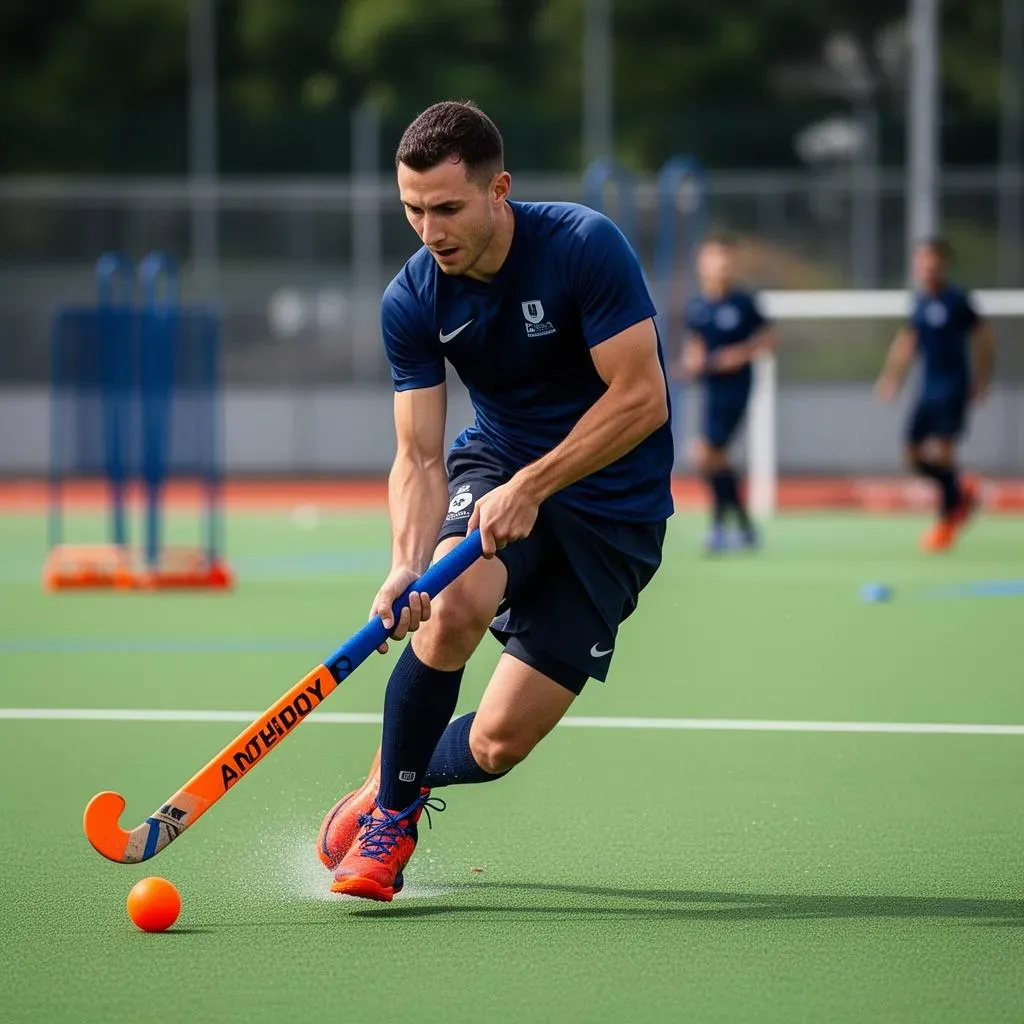
Field hockey has undergone an unprecedented physiological transformation. The introduction of synthetic surfaces and the switch to four 15-minute quarters have transformed this sport into a high-intensity intermittent power-endurance discipline. This guide explores performance determinants and assessment protocols to optimize player potential.
🎯 Want to assess your physical capabilities for field hockey?
Our comprehensive test battery measures all athletic qualities specific to your sport.
Discover Complete TestingThe Evolution of Modern Field Hockey
The shift from two 35-minute halves to four 15-minute quarters has changed effort management. Players can maintain higher relative intensities thanks to additional recovery periods. The unlimited substitution rule ("rolling substitutions") has also changed strategy: players produce repeated maximum intensity sequences, interspersed with bench rest.
GPS analysis reveals an action density higher than football or rugby, with a metric of 120 to 140 meters per minute on average per match. Players cover between 600 and 1000 meters at high intensity (>15.5 km/h) per match.
📊 Key Modern Hockey Figures
- • Total distance: 5,000 to 8,000 meters per match
- • Average intensity: 120-140 m/min
- • High-speed running: 600-1000 m at >15.5 km/h
- • Direction changes: ~14 at high speed per match
Positional Specificity: Distinct Profiles
Treating the team as a homogeneous entity is a major methodological error. Scientific data highlights distinct activity profiles according to playing positions.
🛡️ Defenders
Defenders generally show the lowest total distances and lowest average intensities. They spend a lot of time in "jockey" position (braking retreat), heavily soliciting the posterior muscle chain eccentrically.
Specific needs: Eccentric strength, low position stability, sudden explosiveness to intervene on a launched attacker.
⚙️ Midfielders
The team's aerobic engine. They record the highest total distances and act as the transitional link between defense and attack. Their profile is hybrid: high volume + repetition of high-intensity runs.
Specific needs: Exceptional VO2max, repeated sprint ability (RSA), specific endurance.
⚡ Forwards
The "quality over quantity" profile. Although their total distance is often lower than midfielders, they dominate very high-intensity metrics: number of sprints, maximum accelerations and brutal decelerations.
Specific needs: Explosive power, 0-10m acceleration, lactate tolerance, quick recovery between rotations.
| Indicator | Defenders | Midfielders | Forwards |
|---|---|---|---|
| Total Distance | Moderate | Very High | Moderate |
| Intensity (m/min) | Low to Medium | High | Very High |
| HSR Distance (>15.5 km/h) | Low | High | Very High |
| Sprint Count | Low | Medium | Very High |
| Effective Playing Time | >50-60 min | 40-50 min | 30-45 min |
Fundamental Physical Qualities
🫁 Aerobic Capacity (VO2max)
The aerobic system is the engine for recovery between intense efforts. The higher the VO2max, the faster phosphocreatine resynthesis.
Targets: Elite Men >60-70 ml/kg/min | Elite Women >50-55 ml/kg/min
🔄 RSA Capacity
Repeated sprint ability (RSA) is the most determining quality at the end of a match. It depends on aerobic capacity AND anaerobic buffer capacity.
KPIs: Fatigue index, cumulative time on RSA test
💪 Strength and Power
Strength is not about muscle mass, but about ability to apply force to the ground. Hockey's bent position requires specific strength-endurance.
KPIs: 1RM Squat (>1.7x body weight), CMJ, Grip strength
⚡ Speed and Agility
0-10m acceleration is the king quality for winning loose balls. Reactive agility (response to stimulus) is most representative of real play.
KPIs: 10m time (<1.70s M / <1.90s F), 5-10-5 Tests, 505
Testing Protocols and Assessment
🏃 30-15 Intermittent Fitness Test (30-15 IFT)
This is currently the "Gold Standard" for intermittent sports with direction changes.
Protocol: 40-meter shuttle runs. Athletes run for 30 seconds, followed by 15 seconds of active recovery. Speed increases by 0.5 km/h at each level until exhaustion.
≥22.0
km/h - Elite Men
≥19.0
km/h - Elite Women
🏃♂️ 10m and 40m Linear Sprint
Standing start sprint with timing gates at 0m, 10m and 40m.
≤1.65s
10m - Men
≤1.85s
10m - Women
≤4.95s
40m - Men
≤5.50s
40m - Women
| Test | Unit | Elite Men | Elite Women |
|---|---|---|---|
| 30-15 IFT | km/h | ≥ 22.0 | ≥ 19.0 |
| Yo-Yo IR1 | meters | ≥ 2400 | ≥ 1600 |
| 10m Sprint | seconds | ≤ 1.65 | ≤ 1.85 |
| 40m Sprint | seconds | ≤ 4.95 | ≤ 5.50 |
| 5-10-5 Agility | seconds | ≤ 4.25 | ≤ 4.60 |
| Relative Squat | Ratio | ≥ 1.7x | ≥ 1.35x |
🎯 Ready to measure your performance?
Our comprehensive test battery evaluates all hockey player physical qualities: 30-15 IFT, sprints, agility, strength and power.
Book Complete TestingDevelopment Methodology
Small-Sided Games (SSG)
The modern trend favors small-sided games because they allow simultaneous work on physiological, technical and tactical components. Intensity is dictated by the relative area per player.
📦 Small spaces (<100 m²/player)
Example: 3v3 on 25x25m. Maximizes accelerations, decelerations, direction changes and duels. Ideal for specific aerobic power and muscular endurance.
🏟️ Large spaces (>150 m²/player)
Example: 5v5 or 6v6 on half-field. Allows reaching high speeds (>19 km/h) and reproducing match high-speed running demands.
⚠️ Critical Insight
SSG alone are often insufficient to reach a player's maximum speed. Never running at maximum speed is a hamstring injury risk factor. Complement SSG with analytical running work.
Injury Prevention
Hockey generates specific pathologies that must be actively prevented. The main risk areas are the groin, hamstrings and lumbar spine.
🏥 Groin and Adductors ("Hockey Groin")
Pubic pain prevalence is high due to lateral movements and low positioning. The imbalance between adductors (weak) and abductors (strong) is a major risk factor.
Intervention: Copenhagen Protocol (Copenhagen Adductor Plank) – significantly reduces groin injury risk.
🦵 Hamstrings
Solicited during accelerations in bent position (trunk flexion).
Intervention: Nordic Hamstring Curl for eccentric strength + regular exposures to maximum speed (>95% Vmax).
Goalkeeper Specificity
The goalkeeper is an athlete in their own right. Their physiological profile is radically different from field players. They wear equipment weighing 5 to 10 kg, creating major thermoregulatory constraints.
🧤 Goalkeeper Specific Needs
- • Anaerobic explosive power: Reflex saves, double/triple saves
- • Specific agility: Quick lateral movements with equipment
- • Visual-motor reaction speed: Information processing in milliseconds
Conclusion
The modern hockey player must be a physiological hybrid: able to repeat lactate efforts like a 400m runner, change direction like a basketball player, and possess a solid aerobic base for indefinite recovery.
1
Accurate assessment via valid tests
2
Position-specific load individualization
3
Smart integration (SSG + analytical work)
4
Active prevention of specific pathologies
🏒 Optimize Your Hockey Performance
Our physical preparation team can assess your athletic profile and design a personalized program for field hockey.