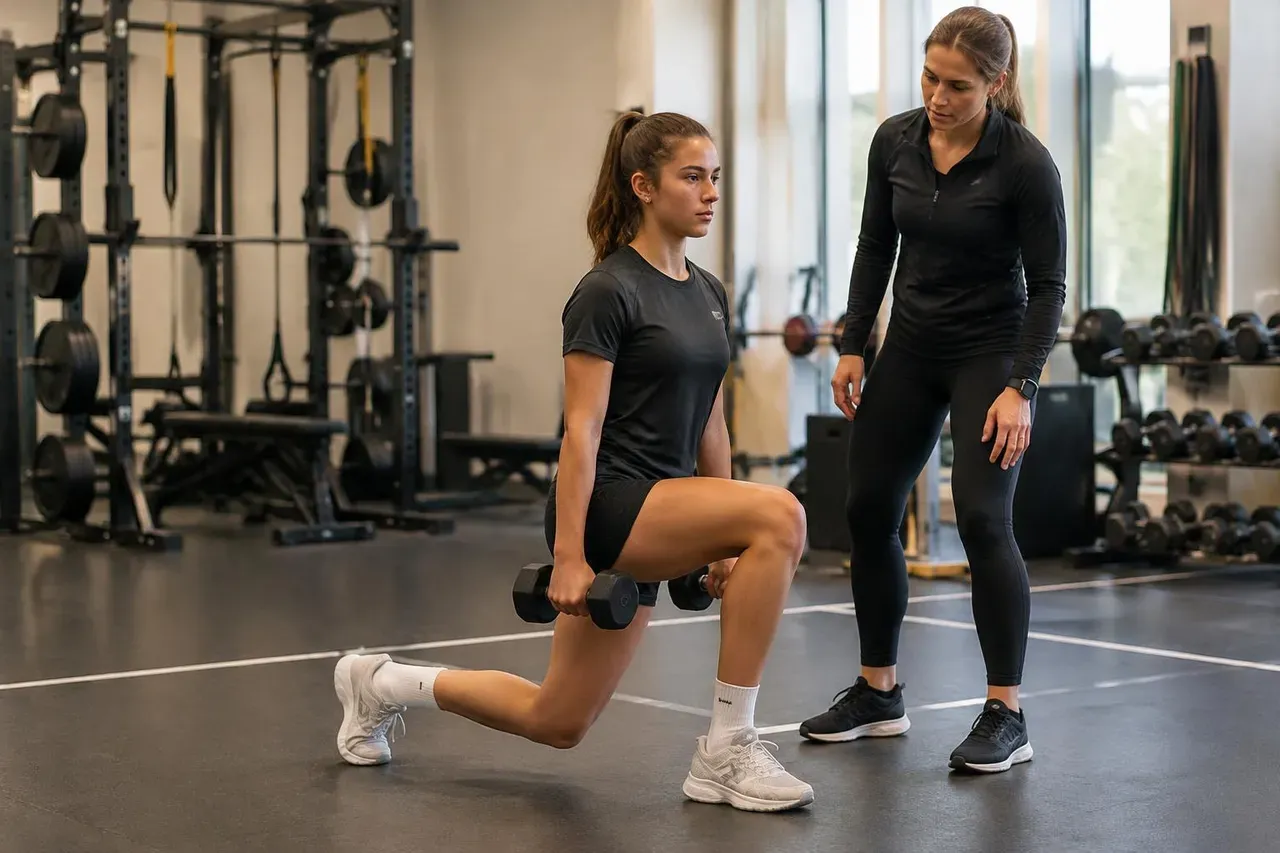

🔥 Your off-season starts now
Unlimited access for 7 days to Physical Preparation and Speed Development sessions.
The season is over. Your body is tired, your mind saturated. Now what? This is where everything is decided. The off-season is not a break. It's the only time of the year when you can truly improve – get stronger, faster, more explosive. It's time to do what others won't.
3+
Strength sessions / week minimum
8–12 wks
Window to truly develop
+15-25%
Potential strength gains in structured off-season
Why the off-season is decisive
During the season, your body is in survival mode. Matches, travel, accumulated fatigue – it all creates a catabolic environment where you're merely maintaining (at best) your abilities. Real progress? Impossible.
The off-season is the only window of the year where conditions align for true development: no weekend matches, no residual fatigue, a favorable hormonal environment (lower cortisol, optimal anabolic ratio). It's now or never.
Athletes who structure their off-season come back stronger, faster and more resilient than those who simply "rest." The difference is visible from the very first weeks of pre-season.
The only time to get stronger
Let's be clear: you cannot get significantly stronger in-season. The concurrent training effect means strength training and sport demands interfere with each other. In-season, you maintain. Off-season, you build.
| Parameter | In-Season | Structured Off-Season |
|---|---|---|
| Maximal Strength | Maintenance or slight decline | +15 to 25% gains |
| Muscle Mass | Stagnation | +2 to 4 kg lean mass |
| Speed (10-30m sprint) | No improvement | -0.05 to -0.15s improvement |
| Power (CMJ) | Fragile maintenance | +5 to 10% jump height |
| Injury Risk | Increased by fatigue | Reduced by targeted strengthening |
💡 The number that matters
Studies show that strength and power gains are +2.2% to +9.8% greater in the off-season compared to attempting the same development in-season. The favorable hormonal environment (DHEA-S/cortisol ratio) explains this difference.
Minimum 3 strength sessions per week
In-season, you might do 1 or 2 strength sessions per week – the bare minimum to avoid losing ground. In the off-season, 3 sessions per week is the minimum for real adaptations. Ideally, aim for 4 to 5 sessions.
Why? Because hypertrophy and strength require volume and frequency. Each muscle group needs to be stimulated 2-3 times per week to maximize protein synthesis. With only 1-2 sessions, you're barely scratching the surface.
📋 Sample weekly schedule
- Monday – Lower Body: Squat, RDL, Split squat, Nordic hamstring
- Tuesday – Upper Body: Bench press, Row, Overhead press, Pull-ups
- Wednesday – Speed & Explosiveness: Sprints, plyometrics, jumps
- Thursday – Lower Body: Deadlift, Step-up, Leg press, unilateral work
- Friday – Upper Body + Core: Explosive movements, push/pull, anti-rotation
- Saturday – Speed Development: Accelerations, change of direction, agility
This volume is what makes the difference. While others rest, you build. And when the season starts, the gap is visible.
Speed and explosiveness training
Strength training alone isn't enough. The strength you build in the gym must be converted into speed and power on the field. That's why speed and explosiveness training is a non-negotiable pillar of the off-season.
⚡ Sprints & Accelerations
Short sprints (10-30m), standing and flying starts. Goal: improve acceleration phase and top speed. 2-3 sessions per week in off-season.
🦘 Plyometrics
Drop jumps, box jumps, bounds, hurdle hops. Develops tendon elasticity and Rate of Force Development (RFD). Essential for change of direction and jumping.
🔄 Change of Direction
COD drills, pro-agility, L-drills. Working on deceleration and re-acceleration – the qualities that separate good from great athletes.
💪 Ballistic Movements
Trap bar jumps, med ball throws, kettlebell swings. The bridge between maximal gym strength and on-field explosive power.
⚠️ Strength ≠ Power
Gym strength doesn't automatically transfer to the field. It must be converted into power through ballistic movements, plyometrics and speed work. Without this conversion, your gains stay in the gym.
Correcting weaknesses and asymmetries
The competitive season exacerbates dominant movement patterns and neglects stabilizer muscles. Result: bilateral asymmetries, strength imbalances and mobility restrictions that worsen month after month.
The off-season is the only window to correct these weaknesses. You can't work deeply on a hamstring/quad strength asymmetry when you have a match every 3 days.
🔍 What we correct in the off-season
- • Strength asymmetries: >10% difference between left and right leg → targeted unilateral work (split squat, single leg RDL)
- • Hamstring/quad ratio: imbalance = major injury risk factor → Nordic hamstring, RDL, eccentric exercises
- • Mobility deficits: hips, ankles, shoulders → daily mobility work + full ROM exercises
- • Core stability: anti-rotation, anti-extension, anti-lateral flexion → Pallof press, dead bugs, farmer walks
- • Muscle fascicle length: shortened by the season → loaded eccentric exercises to restore muscle architecture
The goal isn't just injury prevention – it's removing the brakes on your performance. An athlete without significant asymmetry can express 100% of their potential.
Volume: building the foundations
The off-season is the time to accumulate training volume. In-season, you're limited by recovery between matches. Off-season, you can finally load the bar and increase sets.
The first phase (first 3-4 weeks) should focus on accumulation: 3-4 sets × 8-15 reps at 65-80% 1RM. The goal? Build muscle, strengthen tendons, and lay the structural foundations that will support heavy loads later.
📈 Phase 1: Accumulation (wks 1-4)
- • 3-4 sets × 8-15 reps
- • 65-80% of 1RM
- • Focus: hypertrophy, muscular endurance
- • High volume, moderate intensity
💪 Phase 2: Intensification (wks 5-8)
- • 3-5 sets × 3-6 reps
- • 80-90% of 1RM
- • Focus: maximal strength
- • Reduced volume, high intensity
From hypertrophy to strength and power
The muscle you build in the accumulation phase is the raw material. But muscle without strength is dead weight. The intensification phase converts hypertrophy into maximal strength: heavy loads (≥85% 1RM), low reps (1-5), full rest.
Then comes the conversion to power: ballistic movements, advanced plyometrics, explosive concentric work. It's this sequence – hypertrophy → strength → power – that means you arrive at pre-season fundamentally transformed.
🔗 The development chain
Recovery, hormones and sleep
The off-season is also when your body repairs and adapts. At the end of the season, cortisol is high, testosterone low, sleep often disrupted. The first weeks of off-season restore hormonal balance.
Sleep is your secret weapon. Extending sleep to 9h/night improves strength, motor accuracy and recovery capacity between sessions. You get stronger while sleeping – not while training.
9h
Sleep target / night in off-season
↓ Cortisol
Favorable anabolic ratio for gains
48-72h
Recovery between intense sessions
Practical protocol: your off-season in 3 phases
Decompression & Assessment (Weeks 1-2)
- • Active rest: swimming, light cycling, walking – 3-4×/week
- • Extended sleep: 9h/night minimum
- • Baseline testing: force plate assessment (ForceDecks), asymmetry identification
- • Daily mobility: 15-20 min targeting identified restrictions
Accumulation: Volume & Hypertrophy (Weeks 3-6)
- • Strength training: 4-5 sessions/week (Upper/Lower split)
- • 3-4 sets × 8-15 reps at 65-80% 1RM
- • Asymmetry correction: systematic unilateral work
- • Progressive speed introduction: 1-2 sprint/plyo sessions per week
Intensification: Strength & Power (Weeks 7-10+)
- • Maximal strength: 3-5 sets × 1-5 reps at ≥85% 1RM
- • Power conversion: trap bar jumps, med ball throws, advanced plyometrics
- • Speed: 2-3 sprint/COD sessions per week
- • Re-testing: progress validation on force plates
The 7-Day Pass: your off-season solution
Want to experience what it's like to train like a pro during your off-season? The 7-Day Pass – Physical Preparation (unlimited) gives you access to all Physical Preparation and Speed Development sessions for a full week.
🎟️ 7-Day Pass – Physical Preparation
- ✓ Unlimited access for 7 days to Physical Preparation sessions
- ✓ Speed Development sessions included
- ✓ Coaching by certified strength & conditioning professionals
- ✓ Training on force plates (ForceDecks, Output Sports)
- ✓ Ideal to discover our method and kickstart your off-season
Frequently Asked Questions
How many strength sessions in the off-season?
Minimum 3 sessions per week, ideally 4 to 5. Each muscle group should be stimulated 2-3 times per week to maximize adaptations. It's the volume that makes the difference compared to in-season.
Can you get stronger in-season?
Hardly. The concurrent training effect and match fatigue limit in-season adaptations to mere maintenance. The off-season is the only period where real strength and power gains are possible (+2.2 to +9.8% additional gains).
How to correct asymmetries?
Through targeted unilateral work: split squats, single leg RDL, step-ups. First identify imbalances with force plate testing, then program specific exercises for the weaker leg or side.
Why speed and explosiveness in the off-season?
Gym strength must be converted to on-field power. Without speed training (sprints, plyometrics, ballistic movements), strength gains stay "in the gym" and don't transfer to performance.
What is the Off-Field 7-Day Pass?
It's unlimited access for 7 days to all our Physical Preparation and Speed Development sessions. Ideal to test our method and kickstart your off-season with professional coaching and cutting-edge technology.
🏋️ Do what others won't
Your off-season starts now. Our strength coaches guide you with custom programs, objective data (ForceDecks, Output Sports) and continuous monitoring.