In Switzerland, we live to an average of 83 years. But our healthy life expectancy plateaus at 71 years. This 12-year gap — spent managing chronic diseases, loss of autonomy and frailty — represents the true challenge of modern longevity. This article explains how precision training can compress this period of morbidity and allow you to live fully until the end.
📊 Want to know your real biological age?
Our comprehensive test with force platforms measures your power, RSI-mod and asymmetries to establish your precise neuromuscular profile.
Discover the Complete TestThe Swiss longevity paradox
The Canton of Vaud ranks among the world's most privileged regions in terms of life expectancy. Federal Statistical Office (FSO) data shows life expectancy at birth exceeding 81 years for men and 85 years for women. Yet, WHO statistics reveal a concerning gap: healthy life expectancy (HALE) doesn't exceed 71 years.
Concretely, this means the average citizen will spend more than a decade in functional decline: sarcopenia, type 2 diabetes, mobility limitations, loss of autonomy. This isn't fate — it's the result of an absence of proactive strategy.
📈 Key longevity figures in Switzerland
83 years
Average life expectancy
71 years
Healthy life expectancy
12 years
Avoidable morbidity years
Morbidity compression: a revolutionary concept
Introduced by Dr. James Fries in 1980, the theory of morbidity compression postulates that if the onset of first infirmities can be pushed back faster than the age of death, the total duration of life spent in disability will be compressed at the end of life.
The ideal goal: remain vigorous, autonomous and cognitively alert until 85-90 years, then experience a rapid and brief decline. This is the "rectangularization" of the survival curve. Conversely, the current scenario — experienced by too many people — is "morbidity expansion": saved from a cardiac event at 65 thanks to medicine, they then spend two decades in slow decline.
The silent crisis of the Vaud commuter
The La Côte region (Nyon, Gland, Rolle) presents a paradox: an exceptional living environment between lake and mountains, but a daily reality of constrained sedentariness. About 80% of active people in Switzerland are commuters, with average commute times of 30 minutes — often much more for executives from Gland working in Geneva or Lausanne.
This structural sedentariness is an independent risk factor for mortality and metabolic dysfunction. In other words, 30 minutes of jogging in the evening doesn't "compensate" for the deleterious effects of 9 hours spent sitting.
The neuromuscular cliff: why strength alone isn't enough
One of the most common errors is focusing solely on muscle mass or endurance. While sarcopenia is concerning, power loss (dynapenia) is much faster and functionally more devastating.
📉 Comparative decline rates after age 50
- • Muscle mass: -1% per year
- • Muscle strength: -2.6% to -4.1% per year
- • Muscle power: even earlier and more brutal decline
Power (Force × Velocity) declines faster than pure strength. It's what allows you to recover after a stumble, to react to an unexpected obstacle.
Selective atrophy of fast-twitch fibers (Type II)
The mechanism underlying power loss is the preferential atrophy of Type II muscle fibers (fast-twitch fibers). Human muscle comprises two main types:
🐢 Type I Fibers (Slow)
- • Endurance-oriented, used for posture and walking
- • Very resistant to aging
- • Stimulated by classic endurance activity
⚡ Type II Fibers (Fast)
- • Explosive, powerful — sprinting, jumping, emergency movements
- • Extremely vulnerable to age and inactivity
- • Require intense efforts (heavy loads, rapid movements)
From the thirties, and accelerated after 50, the motor neurons that innervate Type II fibers begin to die. If these fibers aren't regularly solicited, they lose their nerve connection. The individual loses their "spring", their quickness. Classic endurance training (jogging, cycling) isn't enough to prevent this process. Only resistance training targeting speed and load can preserve this vital capital.
The science of measurement: biomarkers and diagnostics
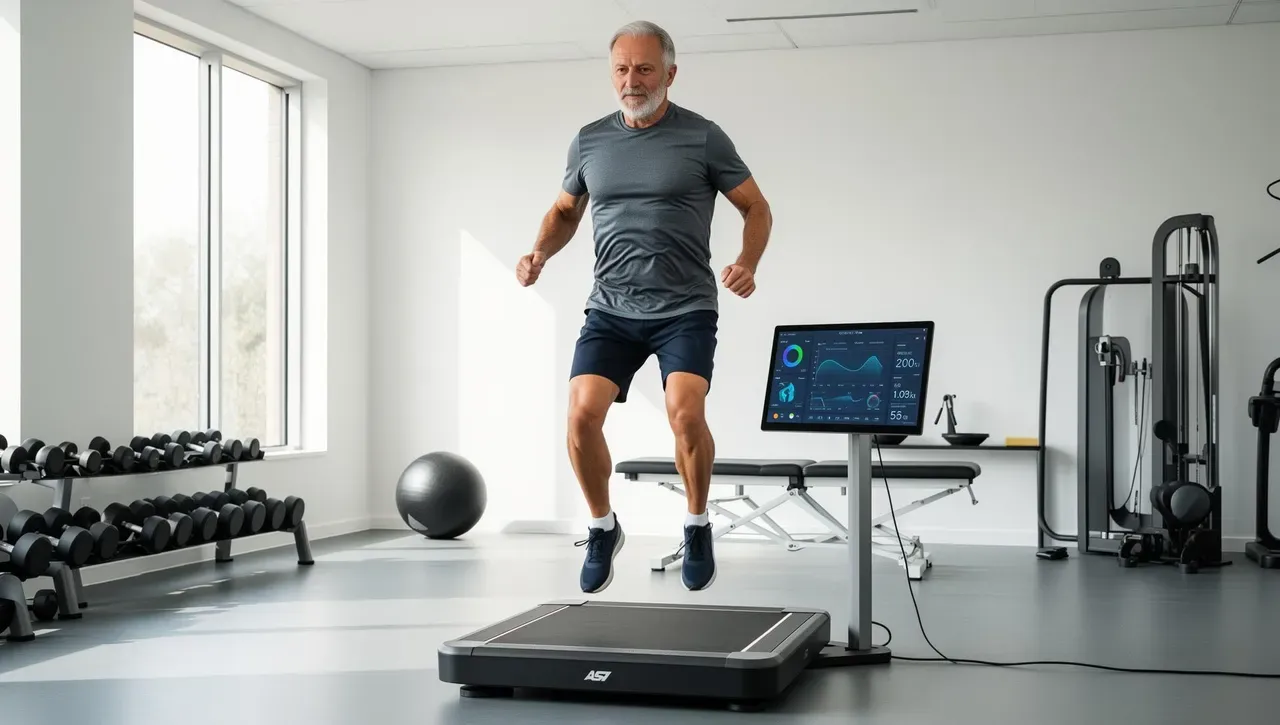
Managing aging starts with its quantification. You can only improve what you measure. Using cutting-edge technologies (VALD ForceDecks force platforms) enables establishing a precise biological "dashboard".
📊 The CMJ: more than a jump test
The Countermovement Jump (CMJ) on a force platform isn't just an athletic test — it's a window into your central nervous system.
- • Jump height: direct correlate of power, proxy for Type II fiber preservation
- • Maximum concentric velocity: declines before height — "canary in the coal mine" for early aging
- • L/R asymmetry: detects invisible imbalances, predictive injury factor
Adherence: the psychological architecture of change
Even with the best science, adherence remains the Achilles' heel of any program. Behavioral economics teaches us that humans suffer from "present bias": we value immediate comfort infinitely more than future benefits.
🧠 Why structure progression?
- 1. Neural adaptation — The first weeks are dominated by neural adaptations. The brain learns to recruit muscles more efficiently. Gains are rapid and gratifying.
- 2. Habit formation — A clear progression reduces the cognitive "friction" associated with training.
- 3. Manageable horizon — The goal is not to promise instant transformation, but to build a realistic and durable system.
Conclusion: redefining longevity
The demographic data for Vaud is clear: we live in a region where longevity is the norm. But the quality of that longevity is still too often left to chance. Morbidity compression isn't a passive event — it's an engineering outcome.
🎯 The ultimate goal
Not to transform every executive into an Olympic athlete, but to give them the physiological reserves of an athlete. The strength to carry their luggage, the power to ski with their grandchildren, and the metabolic resilience to savor local gastronomy without guilt.
This is the promise of precision training: a life that is not only long, but full, vibrant and autonomous to the end.
📊 Measure your biological age
Start with a complete test on force platforms to establish your reference biomarkers. Discover your morbidity compression potential.